
Some chimney stacks in Clifton reach a point where repointing and localised brick repair simply aren't enough. Decades of frost cycles, water penetration and, in some cases, previous repairs carried out with the wrong materials can leave a stack structurally compromised, and at that stage a rebuild becomes the more sensible option rather than continually patching a problem that keeps returning every couple of years. Reaching this point isn't a reflection of poor maintenance so much as the natural endpoint of many decades of weather exposure on an ageing structure.
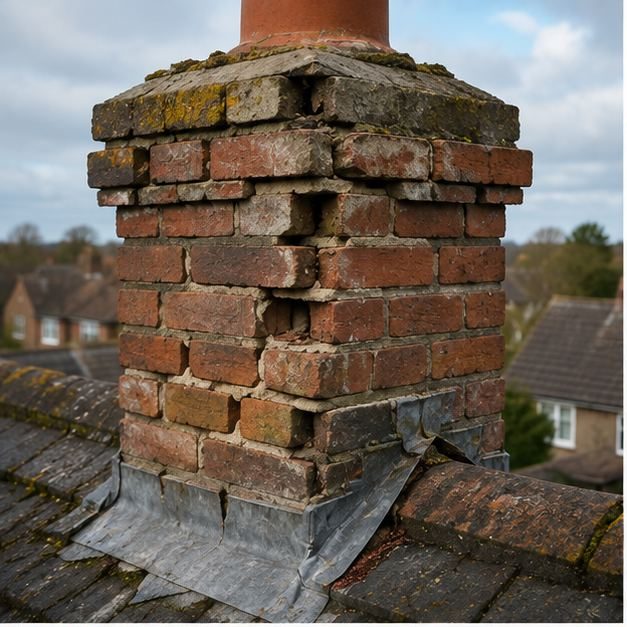
Signs that a rebuild may be needed rather than a repair include a stack that visibly leans, bulges outward, or has cracks running through multiple courses of brick rather than isolated spots. Bricks that crumble noticeably when touched, or mortar so eroded that you can push a finger into the joint, both suggest the deterioration has gone beyond what repointing alone can address and is more structural in nature.
A partial rebuild, taking down and rebuilding the top few courses of brickwork along with the flaunching, is often sufficient where damage is concentrated near the top of the stack, which is typically the area most exposed to weather and most prone to problems. A complete rebuild, taking the stack down to roof level and reconstructing it entirely, is reserved for cases where deterioration runs deeper or the stack's stability is in question throughout its full height. Timescales for this kind of work vary depending on scope, but a partial rebuild is generally a quicker and less disruptive undertaking than homeowners often expect once scaffolding is safely in place.
Matching brick and mortar to the original is a genuine consideration on Clifton's period properties, where a mismatched rebuild can look jarring against a terrace of otherwise uniform Georgian or Victorian brickwork. A good rebuild should be barely noticeable from the street once complete, using brick and a lime-based mortar mix that sits well against what's already there rather than standing out as an obviously modern intervention. Homeowners are often pleasantly surprised at how quickly a skilled bricklayer can make new work sit comfortably alongside old, provided the right materials have been sourced in advance rather than chosen on the day.
Because Clifton's stacks tend to be tall and roofs steeply pitched, scaffolding is standard practice for this kind of work, allowing safe, thorough access rather than relying on partial views from a ladder that can miss the true extent of deterioration further down the stack, particularly on the side facing away from the street. Where a stack serves more than one flue, as is common on larger Clifton properties, a rebuild also offers a good opportunity to check the condition and lining of each flue while access is already in place.
If a chimney on your Clifton property is showing signs of serious deterioration, it's worth having it properly assessed before deciding between repair and rebuild. Brunel Roofing Bristol provides free inspections and a clear, honest recommendation either way, with a full quote to match.
Get a Free Quote for Chimney Repairs in Clifton
Every chimney is different — the fastest way to get an accurate answer is a quick chat with our team.