
Chimneys are one of the few parts of a house that can go completely unnoticed for years, simply because nobody has much reason to look up at them. For homeowners in Horfield, a little periodic attention is really all it takes to catch problems while they are still small and inexpensive to fix, rather than waiting for a leak to force the issue. It is a similar principle to servicing a boiler or clearing gutters, small, regular attention that avoids a much larger bill further down the line.
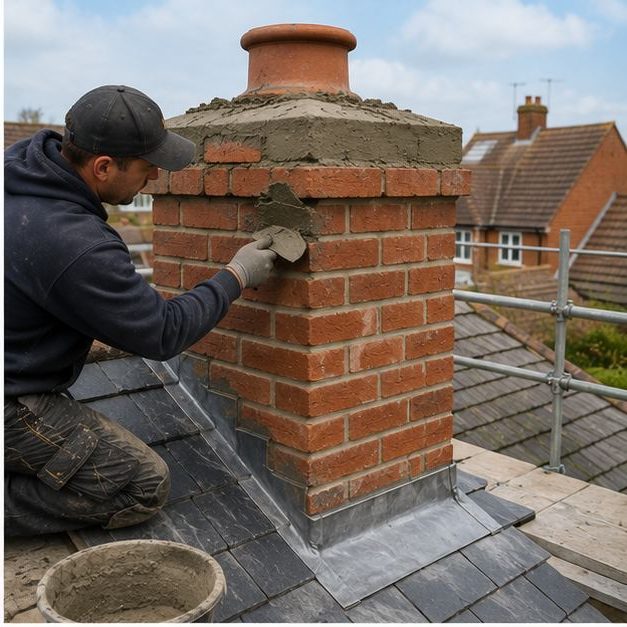
A useful habit is a visual check once or twice a year, ideally after winter and after any particularly severe storm, looking from ground level or an upstairs window for anything obviously amiss: pots sitting at an odd angle, dark staining suggesting damp mortar, or vegetation establishing itself in the joints of the stack. None of these need a scaffolding tower to spot, just a few minutes of attention on a clear day. A pair of binoculars or a zoom lens on a phone camera can make this kind of check considerably easier and more accurate than relying on the naked eye alone.
The mortar joints and the flaunching at the top of the stack are usually the first things to show their age, since they take the most direct weathering of anything on the chimney. On the older brick housing common across Horfield, this is where deterioration tends to start, often years before the brickwork itself shows any real sign of trouble, which makes them a sensible focus for any periodic check. A note or a few photographs kept from each check can also be useful, since it makes it easier to spot gradual changes that might not be obvious from memory alone.
It is also worth having leadwork checked periodically, even though it cannot really be assessed properly from ground level. Flashing and soakers are usually only fully inspected when scaffolding is up for another job or a dedicated chimney inspection, but given how much of a chimney's water resistance depends on this leadwork staying intact, it is one of the more important things to have looked at every several years rather than left indefinitely to fail unnoticed. Many roofing contractors, including ourselves, are happy to include a chimney check as part of any other work being carried out on the roof, which is often the most convenient time to do it.
Disused chimneys deserve attention too. A flue that is no longer in use but left open to the weather is a common, quiet source of damp inside a chimney breast, and capping it properly is a small job that prevents a recurring problem from developing over successive winters. Even a chimney that has never given any trouble is worth including in this routine, since problems tend to develop quietly over several years before finally announcing themselves as a leak.
For a proper maintenance check that covers everything from ground level right up to the pots, Brunel Roofing Bristol offer free inspections for chimneys across Horfield, giving you an honest picture of condition before anything becomes an urgent, more costly repair.
Get a Free Quote for Chimney Repairs in Horfield
Every chimney is different — the fastest way to get an accurate answer is a quick chat with our team.