
A chimney stack stays weatherproof through the combined performance of several separate elements working together — mortar joints, lead flashing, the flaunching at the top, and the pots themselves — and on Redfield's Victorian terraces, where original stacks are often well over a century old, it is common for one or more of these to have quietly deteriorated without anyone noticing until water finds its way inside.
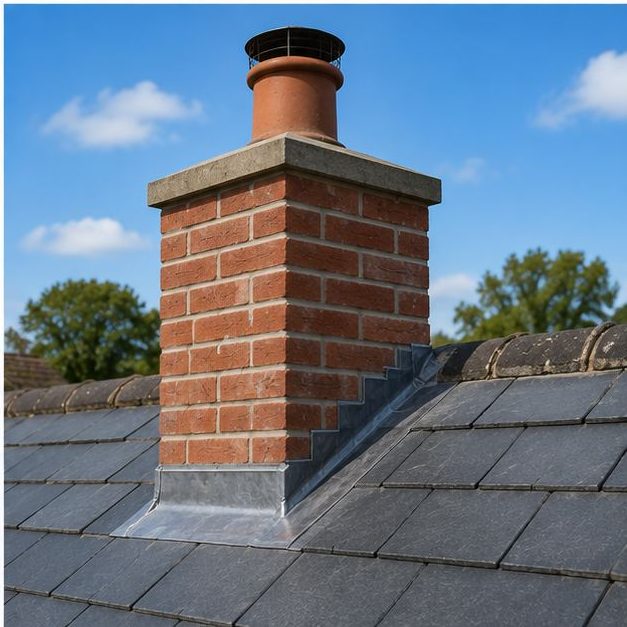
Mortar is usually the first line of defence, and eroded pointing lets water into the brick face itself, where freeze-thaw cycles through a typical winter cause spalling and gradually worsening damage. Lead flashing at the base of the stack, along with soakers and the back gutter on more complex rooflines, handles the join between chimney and roof slope, and is prone to cracking, lifting, or simply wearing out after decades of thermal movement.
At the top of the stack, flaunching — the sloped mortar fillet around the base of the pots — sheds water away from the flue opening and holds the pots securely in place; when it cracks, which it eventually does on almost every stack given enough time, water can track down inside the chimney structure in a way that is very difficult to spot from ground level. Pots and cowls complete the picture, with cowls in particular helping reduce rain ingress and downdraught while deterring birds and squirrels from nesting inside an open flue, a more common problem than many homeowners realise until they have it pointed out to them.
Because these elements interact — failed flaunching often leads to loose pots, cracked mortar accelerates lead flashing failure by allowing more moisture into the structure generally — a weatherproofing assessment really needs to look at the whole stack together rather than treating each part as a separate, unconnected job. On Redfield's older terraced housing, where stacks have often accumulated years of minor unaddressed issues, this joined-up approach tends to catch problems that a narrower repair would miss, and it usually works out more cost-effective than returning to fix each element separately as it fails.
For disused or capped chimneys, weatherproofing still matters — a poorly sealed cap or an unmaintained pot can let water into the void below just as readily as an active flue with failed pointing, so these should not be assumed to be maintenance-free simply because they are no longer in use. A quick periodic check costs little and can prevent damp problems building up unnoticed over several years.
If you'd like a full weatherproofing check on a chimney at your Redfield property rather than a repair aimed at just one visible problem, Brunel Roofing Bristol offers free inspections covering the whole stack from base to pot, with work carried out to a 15-year guarantee and 24-hour emergency call-out for storm-related issues.
Get a Free Quote for Chimney Repairs in Redfield
Every chimney is different — the fastest way to get an accurate answer is a quick chat with our team.