
Spotting the early signs that a chimney needs repointing is worth doing before problems progress to something more expensive, and for Bradley Stoke homeowners a few checks from ground level, ideally with binoculars for anything above eye height, can tell you a surprising amount without needing to get up on the roof yourself. A quick visual sweep of the whole stack, ideally from more than one angle around the property, is worth doing periodically even where nothing seems obviously wrong.
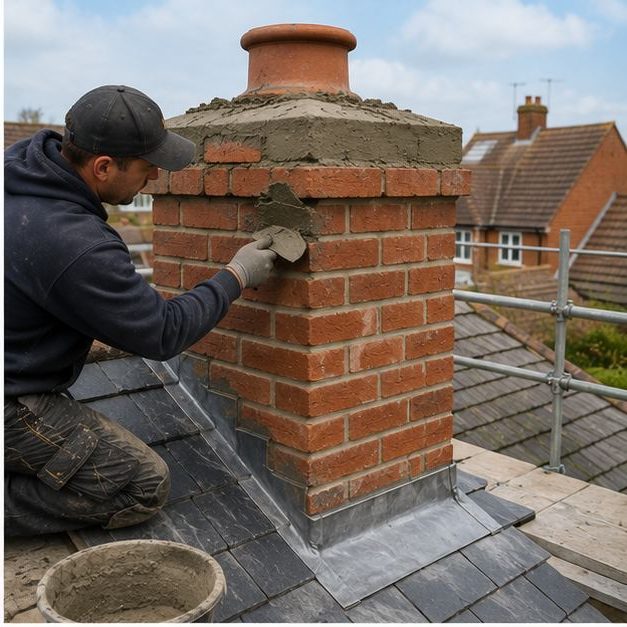
Mortar colour and texture is the first thing to look at. Sound, recently pointed mortar tends to sit roughly flush with, or very slightly recessed from, the face of the surrounding brick, and has a consistent colour across the joints. Mortar that has visibly receded, leaving a noticeable gap between joints and brick faces, or that looks patchy, crumbly or a different shade in places, has typically been eroding for some time and is a reasonably clear sign repointing is due. It is worth checking joints on more than one face of the stack where possible, since weather exposure differs by orientation and a chimney can show clear signs of wear on its windward side while looking comparatively sound elsewhere.
A simpler physical test, where safely accessible, is whether the mortar can be scraped out of a joint with a fingernail or a screwdriver tip with minimal effort. Sound mortar resists this; failing mortar comes away easily in small pieces. This is not something to attempt from a ladder against the chimney itself, but on lower sections or where access already exists it is a useful, low-tech way to confirm what you are looking at.
Vegetation is another giveaway that is easy to miss. Small plants, moss, or grass-like growth rooted directly in mortar joints indicate that enough moisture and organic material has built up in failing pointing to support plant growth, which only happens once joints have been compromised for a reasonable length of time. Similarly, damp patches on a chimney breast inside the house, particularly ones that worsen after rain, often trace back to mortar that has failed enough to let water track through to the inner face of the stack. Discolouration on the brick faces themselves, particularly dark streaking below a joint, can also indicate water repeatedly running from a failing point rather than being shed cleanly away from the surface.
Debris around the base of the chimney or in nearby guttering, especially after a storm or a spell of heavy wind, is worth checking too, since small pieces of mortar or brick coming loose from height are a clear sign that pointing has deteriorated past the point of simply looking a bit tired.
None of these signs on their own necessarily mean urgent work is needed, but together they build a picture worth acting on. If any of this sounds familiar for your Bradley Stoke chimney, Brunel Roofing Bristol can carry out a free inspection and give you a clear, honest recommendation, with repointing work backed by a 15-year guarantee.
Get a Free Quote for Chimney Repairs in Bradley Stoke
Every chimney is different — the fastest way to get an accurate answer is a quick chat with our team.