
The middle of a flat roof is rarely where trouble starts. Edges, trims and the upturns against walls take the movement and the weather, and they fail first.
When a flat roof leaks, the field of the roof is often blameless. The edge where it meets a gutter, the upstand where it rises against a wall, and the trim along the front are all places where one material meets another. On the older houses of Arnos Vale, where extensions have been added to stone and brick walls on sloping ground, these junctions are the usual suspects.
What an upstand is and why it matters
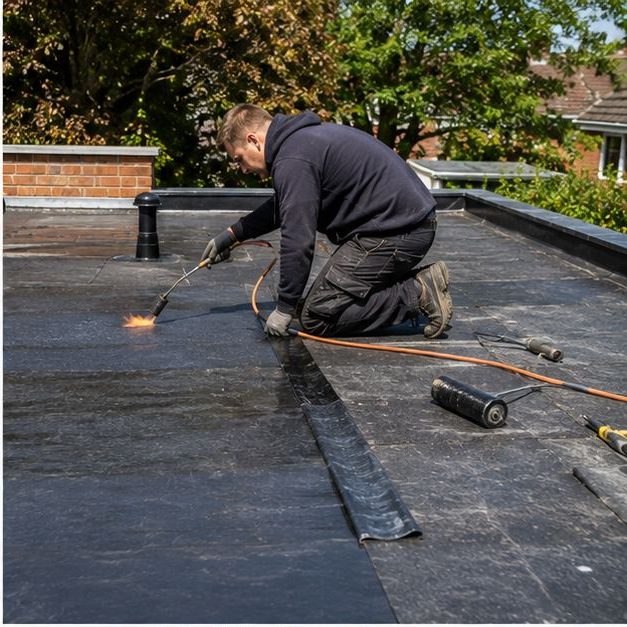
An upstand is the upturned section of the covering that rises against a wall, a chimney, a dormer cheek or a parapet. It stops water running sideways under the covering. It is then finished under a flashing or a sealed joint above. If that upturn is too low, cracked or has come away from the wall, rain gets behind it, and the leak appears on the ceiling inside.
Why joints fail more often than the surface
Walls and roofs do not move together. Temperature changes, damp and the settling of an older extension all pull at the joint between them. Stone and brick walls can also shed mortar and render, leaving the top edge of an upstand with nothing sound to seal into. Over time the sealant dries, the covering shrinks back, and a hairline gap opens that heavy rain exploits.
Edges, drip trims and gutters
At the outer edge the covering should run over a trim and drip clear into the gutter. If the trim is missing, bent or too short, water runs back under the covering or down the face of the wall. Gutters that are blocked or sagging make it worse, because water backs up against the edge. We check the fascia behind it too, since rot there often travels inward.
- Edge trims bent, loose or missing
- Gutters blocked, tilted or leaking at joints
- Fascia boards soft or discoloured behind the roof edge
- Water staining on the wall face below the roof
What we do to put it right
Repair depends on what we find. A sound upstand with a failed seal may be cleaned back, resealed and covered with a new flashing or trim. Where the covering has split or the wall behind is crumbling, we cut out the damaged section, repair the masonry so there is something firm to fix to, and form a new upstand properly. Where the problem runs the whole length, renewing the edge detail is the lasting answer.
Signs you can check from the ground
You can learn quite a lot without leaving the garden or the room below. Look at the gutter for overflow marks, at the wall for dark streaks below the roof edge, and at the ceiling for a stain along the wall line rather than in the middle. Please do not climb up to check; call us for a proper look instead, and we will explain what we find and what can wait.
- Streaks on the wall below the roof edge
- A stain in the ceiling running along the wall
- Water overflowing from the gutter in rain
Frequently Asked Questions
Can an upstand be repaired with sealant alone?
Sealant can help for a short while on a sound joint, but it is rarely a lasting fix on its own. A proper repair usually involves a flashing or trim as well, so the joint does not rely on a bead that will dry out.
Is the leak always at the edge when the stain is near a wall?
Often, but not always. A stain beside a wall may come from the upstand, but it can also come from a blocked outlet or a split elsewhere. We trace it rather than assume, so the repair lands in the right place.
Do I need to replace the whole roof for an edge problem?
No, not if the rest of the covering is sound. A failed edge or upstand can be rebuilt on its own. We would only suggest replacement if the wider surface is also failing, and we would show you why.
Talk to our team about flat roofing in Arnos Vale
Every roof is different — the fastest way to get an accurate answer is a quick chat with our team.