
Most roof trouble comes from a short list of faults, and most are visible from the ground long before they become leaks. Here is what we see most across Hanham's older and newer homes.
Hanham combines older village streets and terraces with inter-war and post-war estates, so the roofs here vary in age and build. Even so, the same problems come up again and again. Knowing them helps you spot trouble early and describe it clearly when you call. Spotting them early keeps repairs small.
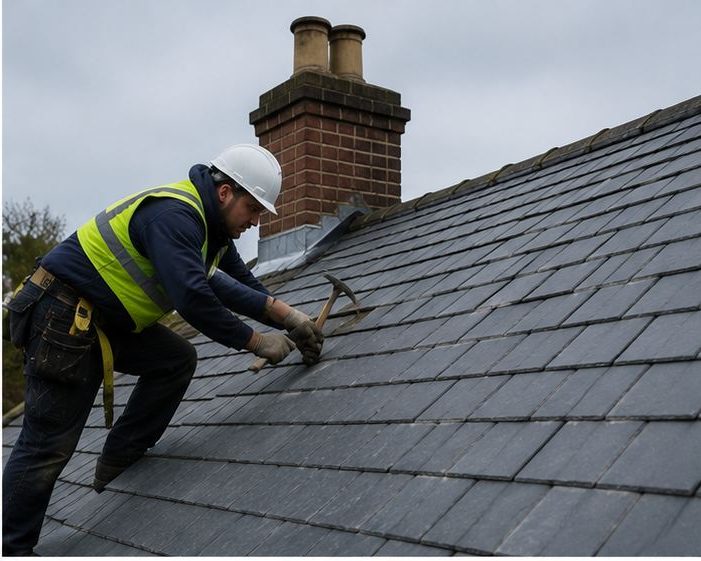
Slipped, cracked and missing tiles
The most frequent fault is a tile or slate that has slipped, cracked or gone altogether. Wind, age and frost all play a part. You may notice a gap in the line of the roof, or pieces on the ground. One lost tile lets water onto the felt below, and over time that leads to leaks and damp timber. Gaps in the line of the roof are often noticeable from the pavement.
Mortar and ridge failures
Mortar along the verge and ridge cracks and falls away with weather. Pieces on a path or drive are a typical first sign. Once the bedding fails, ridge tiles shift and verge tiles loosen. Repair means re-bedding or, at the gable, a dry verge with fixed units. It is a job better done early, as loose pieces are a risk to people below.
- Cracked mortar dropping onto paths and drives.
- Ridge tiles that look uneven or have gaps.
- Verge tiles loosening at the gable.
- Sparrows or bees using the gaps.
Flashings, valleys and chimneys
Lead flashings and valleys take the weather where roof meets wall or chimney. They can lift, split or pull away. Chimney stacks add pointing and flashing that wear out. These junctions are some of the most common sources of leaks, and the damp stain inside can be some distance away. A careful check from roof and loft finds them. Stacks on older houses are particularly prone.
Flat roofs, gutters and boards
Rear extensions, garages and porches often have flat roofs that pool water, blister or split. Gutters block with leaves and moss, overflow and soak the wall or fascia. Timber fascias and soffits rot where water sits. Each of these is easy to see from the ground before it becomes serious, and each has a straightforward fix when caught in time.
- Water pooling on flat roofs after rain.
- Gutters overflowing or dripping at joints.
- Peeling paint and soft patches on fascias.
- Stains on ceilings beneath flat areas.
What is urgent and what can wait
Active leaks, loose tiles and slipping ridge pieces need quick attention. Moss, minor weathering and tired paint can often wait for the right moment. A whole-roof view helps, because it shows what belongs together. We tell you which items are urgent, which can be planned and which you can simply keep an eye on.
Frequently Asked Questions
How often should a roof be checked?
There is no fixed rule, but a look from the ground after storms and a proper inspection when you notice anything odd is sensible. Older roofs benefit from a regular check by a roofer. Photos taken from the ground make a useful record.
Is moss on a roof a problem?
Moss holds moisture and can lift tiles or block gutters. It is not always urgent, but it is worth removing in the right way. Do not jet-wash or scrape it yourself, as that can damage the covering.
Do I need a full roof for these problems?
Rarely. Most faults are fixed with targeted repairs. A full re-roof is for roofs worn out across the board. We look at the whole roof and tell you honestly which situation yours is.
Talk to our team about general roofing services in Hanham
Every roof is different — the fastest way to get an accurate answer is a quick chat with our team.