
A proper leak inspection follows the water from the ceiling to the roof and back again. This is the sequence we use on Hanham's mix of older terraces and inter-war and post-war houses.
When a roof leaks, the useful question is what happens on the visit itself. In Hanham the housing ranges from older village streets to inter-war and post-war estates, so roofs vary a lot in age and build. The method stays the same: listen to the history, look inside, then check outside with care.
The conversation first
We ask where the water shows, when it appears and what the weather was doing. A leak that arrives after wind-driven rain points somewhere different from one that appears after a long wet spell. Photos of past stains and any earlier repairs are useful, because roofs often carry old patches that explain the present trouble.
The loft comes next
With the hatch open and a torch, we look for daylight, drip marks, dark and damp timber, and felt that is stained, torn or sagging. We look at insulation too, since wet insulation tells us water has been arriving for a while. Marks on rafters and battens show the route the water has taken, which usually leads us to the real source.
- Daylight showing where there should be none.
- Dark, damp or soft timber.
- Felt that is torn, stained or hanging low.
- Wet or compressed insulation near the eaves.
Then the covering outside
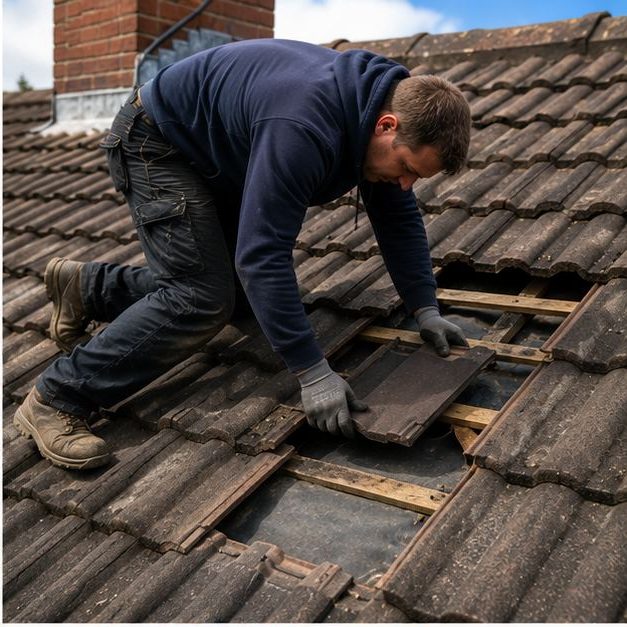
From the roof we check tiles or slates one slope at a time, looking for slipped, cracked and missing pieces. We look at ridge and hip bedding, valleys, lead flashings at chimneys and walls, and the verge and gutter edge. On sloping Hanham streets the roofs facing the open edge towards the river can take the brunt of the weather, so we pay attention to the exposed side.
Gutters, flats and junctions
Leaks are often not in the main slope. A blocked gutter can push water back under the first row of tiles. A rear flat roof, a porch or a bay top can have a split or a failed joint where it meets the main wall. We trace each of these, because the visible damage inside can be some distance from where water gets in.
- Overflowing or leaking gutters and hoppers.
- Junctions between pitched and flat roofs.
- Chimney flashings and stack pointing.
- Roof windows and vents through the covering.
What you are told afterwards
After the inspection we tell you what we found, show you photos and explain what is urgent and what can wait. We also say honestly whether a repair will hold or whether the area is worn out enough that replacing it makes better sense. You should leave with a clear picture, in plain words, of what the work involves.
Frequently Asked Questions
Do you need to go up on the roof?
Usually, yes, because that is the only way to check tiles, ridge and flashings properly. We do it safely with the right access. You should never go up yourself; stay in the loft or on the ground.
Can you find a leak when it is dry?
Often. Marks in the loft, stained felt and damaged coverings remain visible after the rain stops. If the source is still unclear, a controlled water test can reproduce the leak and prove where it comes from.
Will you tell me if it is not the roof?
Yes. Condensation, plumbing, overflowing gutters and failed window seals can all look like roof leaks. If the cause is somewhere else, we say so and suggest who to ask, rather than carrying out work you do not need.
Talk to our team about roof repairs in Hanham
Every roof is different — the fastest way to get an accurate answer is a quick chat with our team.