
The same handful of roofing faults turn up again and again on Nailsea houses. Most start at joins, edges and flat sections, and the open western weather speeds them up. Here is what we see and what it means.
Roofs in Nailsea are mostly post-war and later, with an older core, so the faults are quite predictable. Westerly wind and rain coming off the Somerset levels find weak spots quickly. Most problems start where the roof meets something else or where a covering has simply aged, rather than in the middle of a sound slope.
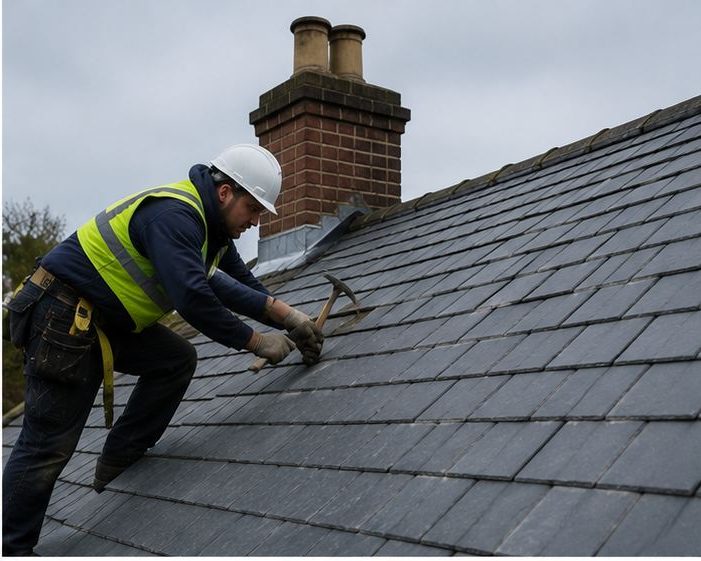
Slipped, cracked and lifted tiles
Tiles move when nails and clips weaken, or when wind gets under an edge. On exposed western slopes, storm-loosened coverings are a frequent finding. A single missing tile can let enough water in to soak felt and timbers below. These repairs are usually straightforward if caught early, and we check the surrounding tiles in case others have started to go as well. If the roof has been repaired before, we note how, since patchwork of different materials tells us where the weak spots are likely to be.
Ridge, hip and verge mortar
Mortar bedding along ridges, hips and gable edges cracks and drops out over time. Loose ridge tiles, gaps at the verge and bits of mortar on paths are the signs. Dry verge systems can replace failed verge mortar, and ridges can be re-bedded or refixed, depending on what the roof needs.
- Cracked or crumbling mortar along ridge and hips
- Loose ridge tiles that rock or sit out of line
- Gaps along gable edges where mortar has failed
- Mortar fragments on paths and drives
Flat roofs on extensions and garages
Flat sections over extensions, garages and porches are common here, and they age differently from the pitched roof. Ponding, blisters, splits and failed joints are the usual faults, and they tend to get worse in the same place each time. Repair works where the deck is sound; widespread failure usually calls for a new covering.
Fascias, soffits and gutters
Timber fascias rot where gutters overflow or paint has failed, and eaves can suffer from blocked ventilation. Gutters sag, leak at joints or fill with debris, and then spill over the boards. Replacing these with UPVC boards, vented soffits and fresh gutters fixes the weak points together, rather than treating each one in turn.
Moss, debris and general wear
Moss and debris build up on shady slopes and in valleys, holding water against the covering. They can block gutters and outlets, too. Removal is best done properly by trained roofers rather than by amateurs on ladders. We look at the whole roof, say what is urgent and what can wait, and leave you with a clear picture of its condition. Gutters and downpipes that run clear matter more than people expect, since overflow soaks fascias and walls.
Frequently Asked Questions
What is the most common cause of a leak?
On pitched roofs, slipped or broken tiles and failed flashings are the usual causes. On flat roofs, it is splits, blisters and failed joints. The cause is often at a junction, not the middle of the roof.
How often should a roof be inspected?
A look after severe weather, and a routine check every so often, catches small faults early. We can inspect from the ground and the loft, and look more closely if something needs it. Hearing about it early helps us plan.
Can I deal with moss myself?
Please do not climb up or use a jet wash. Both can damage the covering and are dangerous. We can remove moss and check the roof beneath it safely. Keep clear of the roof yourself.
Talk to our team about general roofing services in Nailsea
Every roof is different — the fastest way to get an accurate answer is a quick chat with our team.