
A proper leak inspection is a methodical walk through the whole roof, not a quick look at one tile. Here is what we check on Nailsea's estate houses, bungalows and older core properties, and why.
When we come to a leaking roof we do not start with the stain; we start with the weather. Nailsea sits open to westerly wind and rain coming across the Somerset levels, so we ask which way the water arrives and then look for the weakest point on that side. Then we work through each part of the roof in turn.
The conversation first
We ask where the water shows, when it started, and whether it follows wind and rain from a particular direction. A mark that only appears in a westerly gale points to wind-driven rain forced under tiles or round a flashing, while a mark after any rain suggests a more direct fault. Those answers, plus what you have already seen in the loft, save a good deal of searching and let us look in the right place first.
The covering itself
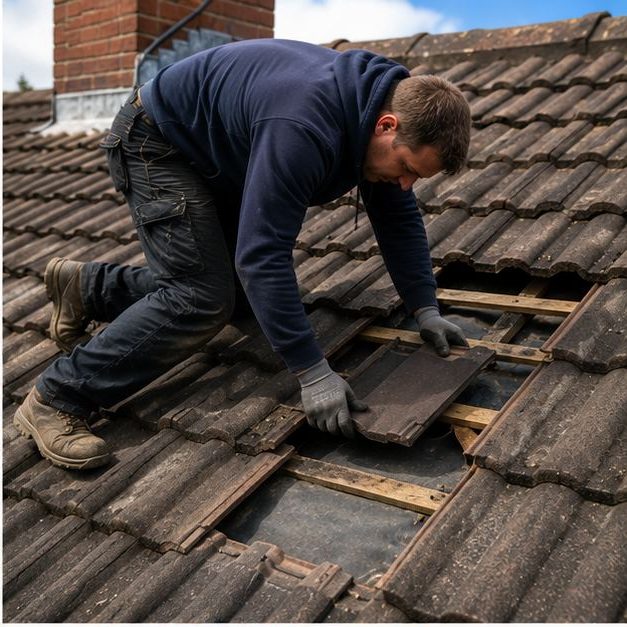
On the many post-war and later houses around the town, the covering is usually concrete or clay tiles, with slate on some older properties. We look for slipped, cracked or missing pieces, tiles that have lifted at the edges and moss or debris holding water where it should shed. Storm-loosened tiles are a frequent finding on exposed western slopes, and a single gap can let in a surprising amount.
- Slipped, cracked or missing tiles and slates
- Worn or lifted edges along the verge
- Debris and moss trapping water against the covering
- Ridge and hip tiles that have loosened or lost bedding
Flashings, valleys and abutments
Anywhere the roof meets something else is a likely culprit. We examine lead flashings round chimneys, valley gutters between slopes, and the junction where a roof runs up against a wall, such as a porch, extension or garage. Failed sealant, lifted lead and rusted fixings all let water in. On bungalows and extended estate houses, there are often several such joins, and each one gets checked.
Inside the roof space
From the loft we look for daylight where there should be none, dark or damp timbers, stained or torn felt and wet insulation. Following the water along rafters and battens usually leads us back to the entry point on the roof outside. We also look at ventilation, as condensation in a roof with poor airflow can drip and look just like a leak.
What you get at the end
We explain what we found in plain terms, show you where we can, and say what is urgent and what can wait. If a temporary fix is needed to stop water while a proper repair is arranged, we say so. If the roof is in a good state overall, we will tell you that too and avoid recommending work it does not need.
Frequently Asked Questions
Will the roofer need to go into my loft?
Usually yes, if there is access, because the underside tells us a lot. A clear route to the hatch and a little space to look around is all that is needed. Please do not move heavy items or step between the joists yourself.
Can a leak be found when it is not raining?
Often, yes. Damp timber, stained felt and daylight through the covering do not disappear when the rain stops. In some cases we also look again in wet weather to confirm that a repair has worked.
Is the inspection only about the roof covering?
No. We look at the covering, ridge, verges, flashings, valleys, gutters and fascias, and the loft. Leaks often come from the joins and edges rather than the open field of tiles, so every part is checked.
Talk to our team about roof repairs in Nailsea
Every roof is different — the fastest way to get an accurate answer is a quick chat with our team.