
Most roof trouble on Ridgeway's mixed housing falls into a handful of types. Here is what we see most often and how each tends to show up.
The houses around Ridgeway are a mix of inter-war and post-war builds, many with hipped roofs, plus garages and extensions. Their roofs tend to age in similar ways. This guide covers the common problems, the signs you can spot from the ground and what we usually do about them.
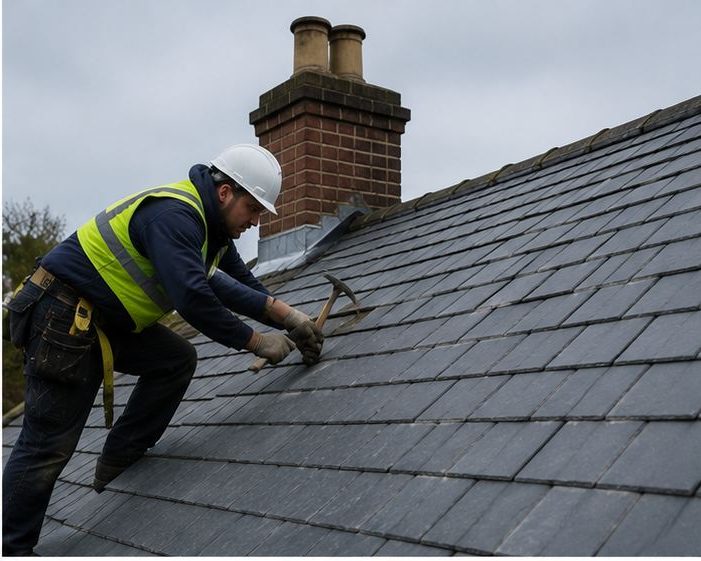
Slipped and cracked tiles
Tiles shift when their fixings loosen or the felt beneath perishes, and frost and wind crack others. You can sometimes see a gap or a tile sitting out of line from the pavement. A single slipped tile is a quick repair; many together suggest an ageing covering.
Weather in the Bristol area is mild but wet, with gusty winds, and that is enough to work loose a covering that is past its best. Tiles from the inter-war and post-war periods can be sound for a long time, but the fixings, felt and bedding around them age at different rates.
Hips, ridges and bedding
Hipped roofs have long hip lines as well as a ridge, and the bedding that holds the tiles can crack and drop out. Look for pieces of mortar on paths or cracks along the lines. Re-bedding or mechanical fixing keeps rain out and the capping tiles in place.
- Cracked or missing mortar along hips and ridge
- Capping tiles sitting loose or out of line
- Pointing crumbling onto paths and drives
- Leaks showing in ceilings near hip corners
Flat roofs on garages and extensions
Garage and extension roofs often use felt or similar coverings that wear. Ponding, cracks, blisters and failed edges are the usual signs. We repair where the roof is sound enough, and replace where faults are widespread, with a covering that suits the shape and use of the roof.
Gutters, fascias and soffits
Blocked or sagging gutters, rotten fascia boards and tired soffits all let water in at the eaves. Many houses still have timber boards that rot where water sits. Replacing them with UPVC, with vented soffits, is a common job and often solves several problems at once. Overflowing gutters can also stain walls and damp internal plaster.
Blocked gutters are especially common near trees and under overhanging branches. Leaves and moss collect and water spills over the edge, running down walls and behind fascias. Clearing gutters is a simple job, but it is worth doing before winter, since an overflow can damage boards and brickwork quickly.
Flashings, chimneys and verges
Where the roof meets a chimney, wall or neighbour, flashings can lift or crack. Chimney pointing and caps age as well. At gable ends, mortar on verges cracks and falls out. These details are small, but they are where leaks often begin, and we look at them whenever we inspect a roof.
Frequently Asked Questions
Which problem is the most urgent?
Anything letting water in, particularly near electrics or over bedrooms, comes first. Loose tiles that could fall also matter. Cosmetic issues like moss can usually wait. We explain the order when we inspect.
Is moss a problem on my roof?
Moss holds water and can lift tiles or block gutters, so it is worth dealing with, but it is not always urgent. We remove it carefully and check the covering beneath. Please do not scrape or jet-wash it yourself.
How can I check my roof without climbing up?
Look from the pavement or garden, with binoculars if you have them. Check for slipped tiles, sagging gutters, loose capping and stains on walls. Check the loft from the hatch for daylight and damp. Then call us for a proper look.
Talk to our team about general roofing services in Ridgeway
Every roof is different — the fastest way to get an accurate answer is a quick chat with our team.