
A proper leak inspection is a set of checks in a sensible order, inside and out. Here is what we look at on the hipped, inter-war and post-war roofs around Ridgeway.
When you call about a leak, you should know what the visit involves. On Ridgeway's mix of inter-war and post-war houses, we work through the loft, the hips and ridge, the main covering and any extension roofs. Each check rules something in or out until the real source is found.
A conversation first
We ask where you see the water, when it appears and whether it follows wind or long rain. We also ask about past repairs and any building work. Those answers often narrow the search before anyone looks at a tile, and they save time on the day.
It also helps to tell us about anything that changed shortly before the leak started, such as a storm, a boiler flue, a satellite dish or work by another trade. Small clues like these can explain a fault that looks like a mystery, and we note them alongside what we see in the loft and on the roof.
The loft and the ceilings
In the roof space we look for daylight, stained felt, wet or dark timber and damp insulation. We follow the water back to its highest point, since it runs downhill along the underside of the covering. Ceilings and walls below are checked for damp, so we understand how far it has travelled.
- Daylight showing where the covering should be closed
- Dark staining or tide marks on rafters and felt
- Damp insulation, especially near a hip or wall
- Mould or a musty smell in the roof space
Hips, ridge and the main slopes
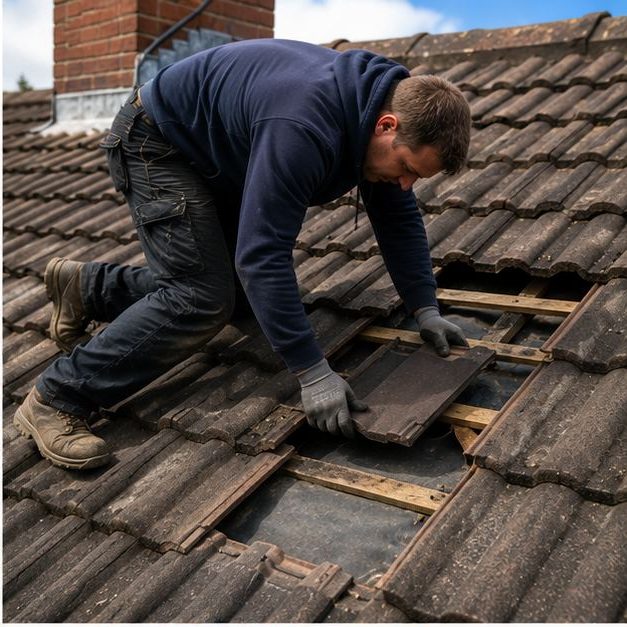
On a hipped roof there is more ridge and hip line than on a gable-ended one, and each of those joins is bedded in mortar or fixed with clips. We look for cracked bedding, slipped hip tiles and open joints, then check the main slopes for cracked, loose or missing tiles.
Extensions, garages and details
Many houses here have had extensions or garages added, and the joint where an extension meets the old roof is a common leak point. We check flashings, the abutment with the house wall, gutters, valleys and any flat roof section, since water can enter at the junction rather than the roof itself. We also look at chimneys, soil pipe exits and roof vents where they pass through the covering, because those are places where flashings and seals wear.
What you get afterwards
We tell you what we found, show you photographs and say what is urgent and what can wait. If a repair will do, we say so. If the roof is failing more widely, we explain that and what the options are, so you can decide with the facts in front of you.
Where the cause is plain, we can often explain the repair on the spot. Where it is not, for instance because the water has travelled a long way, we tell you what we have ruled out and what we want to look at next, rather than guessing and leaving you with a patch that fails.
Frequently Asked Questions
Will the roofer need to go inside my house?
Yes, usually to reach the loft hatch and sometimes to check ceilings below. We keep the visit tidy and tell you what we need to see. Clear access to the hatch beforehand makes the inspection quicker.
Can a leak be found when it is not raining?
Often, yes. Signs such as stained felt, damp timber and slipped tiles stay visible in dry weather. In some cases we test with water to find the entry point. We do not need rain on the day.
Does the roofer just look at the leaking spot?
No. A leak is a clue to a fault elsewhere, and other weak points may sit nearby. We look at the whole slope and the details around it, so a repair at one place does not leave the next fault waiting.
Talk to our team about roof repairs in Ridgeway
Every roof is different — the fastest way to get an accurate answer is a quick chat with our team.