
It isn't always the wind that causes the most damage during a storm; heavy, prolonged rain has its own way of finding weaknesses in a roof that a single gust might never expose. For properties across Lawrence Weston, some of the leaks that appear after a spell of sustained heavy rain trace back to problems that had been sitting quietly on the roof for some time, only becoming apparent once enough water was thrown at them.
Guttering plays a bigger role here than people often expect. Heavy rain can overwhelm guttering that's partially blocked with leaves or debris, causing water to overflow back towards the roof edge or run down behind fascia boards rather than being carried away properly, and this kind of water ingress can happen even on a roof with no obviously damaged tiles.
Small gaps that wind alone might never exploit, such as a slightly displaced tile or a hairline crack in ageing flashing, become a much more direct route for water once rain is heavy and sustained rather than brief. This is part of why leaks sometimes appear after a long, wet spell of weather rather than during the more dramatic, windy part of a storm.
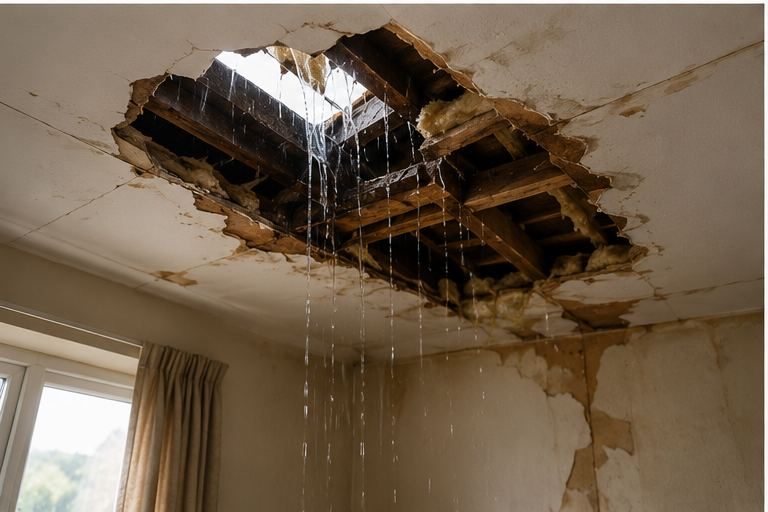
Once water is getting in, it doesn't necessarily show up straight away or directly below its actual entry point. It can travel along rafters, pool briefly in insulation, or run down inside a wall cavity before eventually appearing as a stain on a ceiling or wall, which is why tracing a heavy rain leak properly usually benefits from a proper roof-level check rather than assumptions made from where the damage shows indoors.
Blocked or poorly maintained guttering is worth checking specifically after this kind of leak, since it's one of the more preventable causes and one that doesn't require any actual damage to the roof covering itself to cause a problem. Clearing debris from guttering periodically, particularly in autumn when leaves are more likely to accumulate, reduces the chance of heavy rain overwhelming the system and finding its way in around the roof edge. Where a leak has appeared during a genuinely exceptional spell of rain rather than a windy storm, it's still worth having the roof checked afterwards, since the underlying weakness that let water through will still be there the next time heavy rain returns to Lawrence Weston. It's also worth having downpipes checked as well as guttering itself, since a downpipe that's become partially blocked or disconnected lower down can cause water to back up during exactly the kind of sustained heavy rain that tends to expose this type of problem. A full check of the drainage route, from roof edge down to ground level, gives a more complete picture than looking at the guttering alone.
If heavy rain has left your Lawrence Weston property with a leak, getting it looked at promptly limits how much further damage accumulates. Brunel Roofing Bristol offers a 24-hour emergency call-out alongside free inspections to identify exactly where water is getting in and get it properly resolved.
Need Emergency Roof Repairs in Lawrence Weston?
Every case is different — the fastest way to get an accurate answer is a quick chat with our team.