
Rain that falls straight down and rain that's being driven sideways by wind behave very differently once they reach a roof, and it's the second kind that tends to catch homeowners out year after year. A roof covering that copes perfectly well with an ordinary shower can still let water in during a storm where rain is being blown almost horizontally, finding its way under laps and joints that were never designed to face that kind of pressure head-on. It's a distinction that catches out even attentive homeowners, since a roof can pass a casual visual check with flying colours and still be vulnerable to this specific kind of weather.
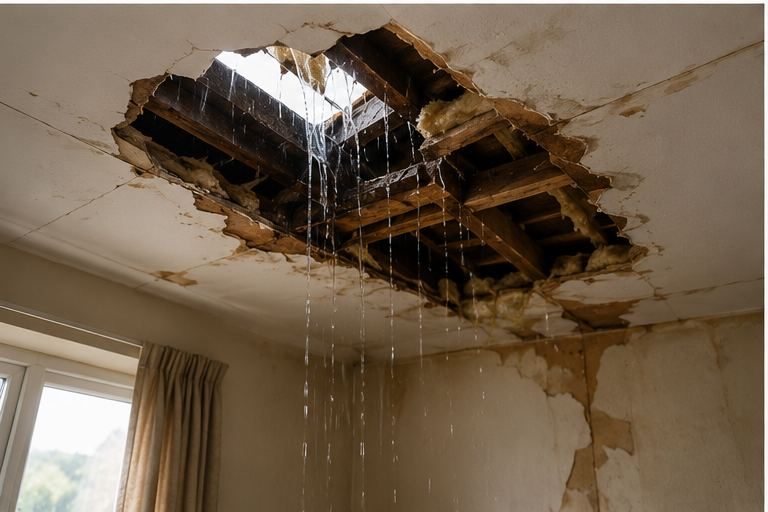
Sneyd Park's position, close to open ground near the Avon Gorge, means some properties here are more exposed to this kind of wind-driven weather than roofs in more sheltered parts of the city, and it's worth bearing that in mind when a leak appears only during the worst storms rather than during ordinary rainfall throughout the rest of the year without any issue at all. Trees and boundary walls that might otherwise provide some shelter are often further away here than in more built-up parts of the city, leaving roofs with less protection from the prevailing wind direction.
Driving rain tends to find its way in through slightly different weak points than standing water would, forcing itself under tile laps, through hairline gaps in mortar-bedded ridges and verges, and past flashing that's marginally lifted but wouldn't normally let water through under gentler conditions on an ordinary day. This is why some leaks only ever show up during a genuine storm and stay completely dry the rest of the time in between. Even a well-maintained roof can develop this kind of leak eventually, simply because materials that were installed correctly can still shift very slightly over years of thermal movement and settling.
Because the symptoms can be intermittent, tracing this kind of leak sometimes takes a bit of patience, checking the roof and loft space methodically and, where possible, during or shortly after a spell of driving rain rather than relying on a dry-weather inspection alone to find the fault causing it. Some homeowners find it useful to note exactly when a leak appears, since a pattern linked specifically to wind direction can help narrow down which side of the roof is actually affected.
Once the entry point is identified, the fix usually involves tightening up the specific weakness, re-bedding a section of ridge or verge, re-dressing flashing, or resetting tiles that have shifted just enough to let wind-blown rain past, rather than a general overhaul of the whole roof that isn't actually needed in most cases. Because the fix is usually localised, the disruption involved is generally minimal compared with a full re-roof, which is reassuring for anyone worried about the scale of the work involved.
If your Sneyd Park property develops leaks specifically during storms, Brunel Roofing Bristol can carry out a thorough inspection to identify the cause, with a free quote for whatever repair is needed to keep driving rain out for good this time round. Identifying the precise cause, rather than guessing, is what makes the difference between a repair that lasts and one that needs revisiting after the next spell of driving rain.
Need Emergency Roof Repairs in Sneyd Park?
Every case is different — the fastest way to get an accurate answer is a quick chat with our team.