
A roof valley, the internal angle formed where two sloping roof sections meet, is one of the hardest-working parts of any roof, channelling a large volume of rainwater down towards the guttering below. On Montpelier's period properties, valleys are frequently lined with lead or an older material that has been in place for many years, and this concentration of water flow makes valleys especially vulnerable when a storm brings heavy rain alongside strong wind.
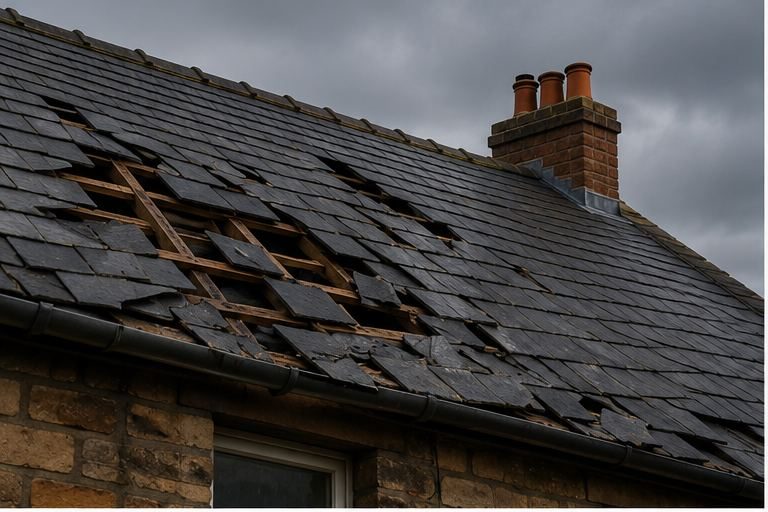
During normal weather, a well-maintained valley copes easily, but storm conditions change the picture in two ways. First, the sheer volume of water can overwhelm a valley that has debris, moss, or a partial blockage reducing its effective capacity, causing water to back up and find its way under adjacent tiles or slates instead of running down the valley as intended. Second, wind-driven rain can be forced sideways into laps and joints along the valley edges that would never be tested by rain falling straight down.
A leak connected to a failing valley often shows up as damp staining on a ceiling some distance below the valley itself, since water can travel along the underside of the roof covering before finding a gap to drip through. This can make the source confusing to trace from inside the house, which is why checking the valley itself, rather than just the ceiling directly underneath the stain, is usually the right starting point.
Montpelier's terraced layout means valleys often appear at the junction between a main roof slope and a rear closet wing or extension, a very common configuration on Victorian housing in this part of Bristol. These valleys can be harder to see from the street than a ridge or chimney, and are sometimes overlooked during a quick visual check, which is exactly why they are worth including deliberately in any post-storm inspection rather than assumed to be fine. A valley hidden from street view is no less important to check than one that is obviously visible, and in many cases it is the rear valleys, out of sight of passers-by, that end up neglected the longest before a problem is finally noticed.
Repairing a valley properly means clearing any blockage first, checking the condition of the lining material along its full length, and assessing whether the surrounding tiles or slates that dress into the valley are still properly seated. Where the lining itself has split or corroded, replacement with new leadwork or an appropriate modern equivalent, correctly formed and dressed, is usually the most reliable long-term fix rather than a localised patch.
If you have a leak that seems to trace back to a valley on your Montpelier roof, particularly one that has worsened after recent storms, it is worth having it inspected properly rather than waiting for the next heavy downpour to make things worse. We offer free inspections and our completed repairs carry a 15-year guarantee.
Need Emergency Roof Repairs in Montpelier?
Every case is different — the fastest way to get an accurate answer is a quick chat with our team.