
A roof valley, the internal angle formed where two roof slopes meet, is one of the busiest points on any roof, channelling rainwater from two directions down towards the guttering. On Clifton's period properties, many of which have complex rooflines with multiple valleys, this detail is also one of the more common sources of a storm-related leak, and understanding why can help homeowners recognise the warning signs early, well before a leak actually reaches the inside of the property.
Because a valley collects water from two roof slopes rather than one, it deals with a proportionally greater volume of rainfall than a flat expanse of roof covering, which means any weakness at this point is exposed more quickly than elsewhere. Storm debris, including leaves, moss and broken fragments of slate or tile, also tends to collect in valleys, and a build-up here can cause water to back up under the surrounding covering rather than flowing away as intended. This backing-up effect can happen even where the valley lining itself is in reasonable condition, simply because debris has narrowed the channel enough to slow drainage during a heavy downpour.
The lead or valley lining itself can also be damaged directly by storms, whether through wind lifting an edge that has begun to work loose, or through impact from debris carried across the roof in strong gusts. Once the lining is compromised, even in a fairly small area, water can find its way underneath the surrounding slate or tile and travel some distance before appearing as a leak inside the property.
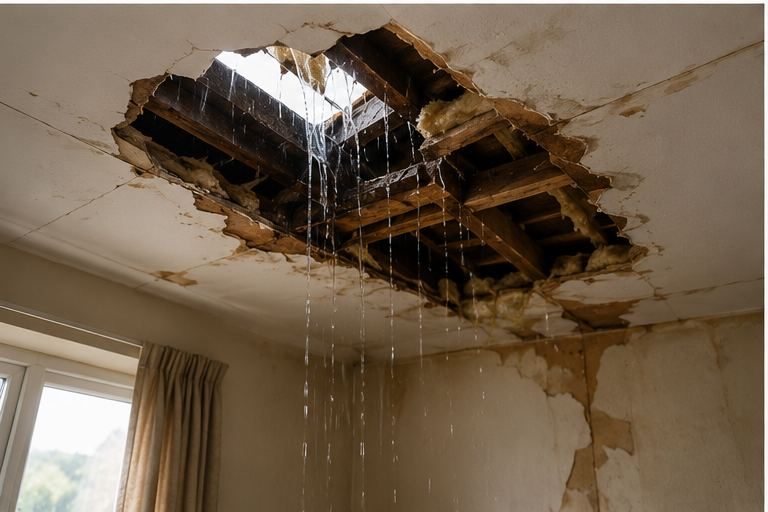
This is part of why valley leaks can be genuinely tricky to trace, since the point where water enters the roof structure is not necessarily anywhere near where it eventually drips through a ceiling. An experienced roofer will typically examine the whole valley, including the condition of the lining and the slates or tiles either side of it, rather than assuming the first visible sign of damage is the full extent of the problem. Where a valley serves a particularly large area of roof, even a modest weakness can end up dealing with a considerable volume of water during a genuinely heavy storm.
Because valleys are subject to more wear than a typical roof slope simply by virtue of the water volume they handle, older valley linings on Clifton properties are sometimes closer to the end of their working life than the surrounding roof covering, which is worth bearing in mind if a valley-related leak recurs after an apparently successful repair. In that situation, a full relining of the valley is often a more durable solution than yet another small patch.
Brunel Roofing Bristol regularly repairs storm-damaged roof valleys across Clifton's period properties and offers free inspections to trace the source of a leak accurately before recommending a repair, with emergency temporary weatherproofing available in the meantime where needed, day or night.
Need Emergency Roof Repairs in Clifton?
Every case is different — the fastest way to get an accurate answer is a quick chat with our team.