
People often use the three words as if they meant the same thing. Here is what each part of the roof edge does, and how to tell which one is giving trouble on your house.
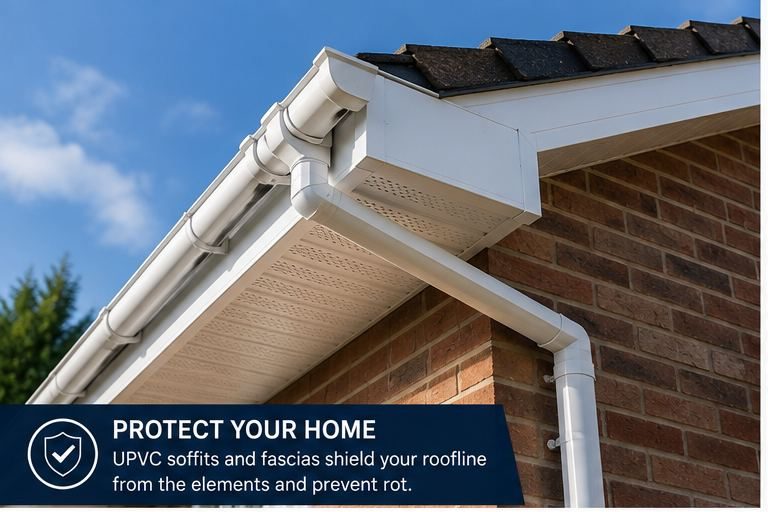
Standing outside a Brislington semi and looking up at the eaves, you are seeing three separate parts working together: the fascia, the soffit and the gutter. When one fails, the others usually suffer. Knowing which is which makes it much easier to describe a problem and to understand a quotation when you get one.
The fascia: the board you see from the front
The fascia is the long board fixed across the ends of the rafters, running along the edge of the roof. It carries the gutter on its face and gives the roofline a finished look. On older homes it is often painted timber; on newer work it is UPVC. A sagging gutter is frequently a fascia problem, not a gutter problem. On extensions and garages it is the same board, just shorter.
The soffit: the board you see when you look up
The soffit closes the underside of the eaves, between the wall and the fascia. It stops birds, insects and weather getting into the roof space, and a vented soffit also lets air move through the loft. Peeling paint, dark staining or a gap between wall and board suggests moisture has been getting at it. Soffits are easy to overlook because they face downwards.
The guttering: the channel that moves water away
Gutters collect rain from the roof and carry it to the downpipes. They are fixed to the fascia, so they depend on it. Blocked or leaking gutters spill water over the fascia and soffit, which is how rot begins. Water marks down the wall, overflow in storms and green growth at joints are the usual signs. Clearing gutters regularly from ground level is not possible, so overflowing ones need a proper look.
- Sagging gutter: check the fascia behind it
- Peeling or stained board under the eaves: soffit
- Water running down the wall: gutter or joint
- Rotten or soft board edge: fascia or bargeboard
Where bargeboards fit in
On a gable end, the board along the sloping edge is called a bargeboard. It does the same job as a fascia, but at the side of the roof rather than the bottom. Hipped roofs, common on Brislington's semis, have little or none, while gable-ended extensions and garages often carry them.
Why we look at all three together
Because water lands on one, drips onto the next and rots the third, we check the full eaves line when called to a single fault. The gutters, boards and rafter ends are inspected from the ground first and then close up. We explain what is worn, what can stay and what should be renewed. That way, nothing is left to cause trouble later.
Frequently Asked Questions
Can I replace just the gutters and leave the fascia?
You can if the fascia is sound, but fitting new gutters to rotten or warped boards is false economy. We check the boards first and tell you honestly whether the gutters can go straight onto what is there. The cost of doing the job twice is not worth it.
Do soffits need vents?
A vented soffit or vent strips let air move through the roof space, which helps stop condensation and damp. When we replace soffits we include ventilation so the loft can breathe, and we check that insulation is not blocking the airflow. Ventilation matters more in a house with a boarded loft.
Which board should be UPVC and which can stay timber?
There is no rule, but UPVC is very low maintenance and is cleaned rather than painted. Where timber is still sound, it can stay. We look at the condition of each board and advise on what makes sense for the house.
Talk to our team about UPVC fascias and soffits in Brislington
Every roof is different — the fastest way to get an accurate answer is a quick chat with our team.