
Chimneys and leadwork are some of the most detailed, and often most vulnerable, parts of the many period roofs found across Hotwells, and they are also exactly the kind of area where moss tends to accumulate most heavily. That combination makes them worth paying particular attention to, more so than open, flat areas of roof.
Chimney stacks create natural shading and shelter on a roof slope, and the junction where a chimney meets the roof surface tends to collect moisture, debris and moss more readily than open areas of tile or slate. On the Georgian and Victorian properties common in Hotwells, this junction is also usually where leadwork, in the form of flashing, has been used to keep water out, and it is a detail that requires regular attention over the decades to keep performing properly and reliably.
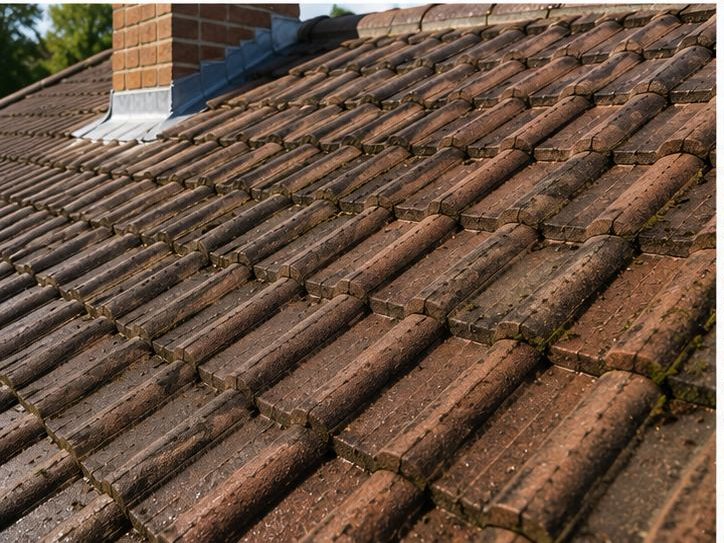
When moss builds up thickly around a chimney base, it can completely cover the flashing beneath it, making it very difficult to judge the condition of the lead just by looking. Flashing that has lifted slightly, cracked, or corroded can sit hidden under moss growth for a long time without an obvious sign of a problem, right up until water finds its way through during a period of heavy or driving rain that reveals the weakness suddenly.
Mortar fillets, sometimes used around chimney bases on older properties in the area as an alternative or addition to lead flashing, are similarly vulnerable. Mortar naturally degrades over time, and moss growing into these gaps can mask cracking or crumbling that would otherwise be a visible warning sign that repair work is needed sooner rather than later.
This is one of the reasons a careful, professional assessment matters more around chimneys than almost anywhere else on the roof. Removing moss from this area needs to be done gently, since disturbing already compromised flashing or mortar carelessly can create a leak that was not there before the cleaning started, rather than simply revealing an existing one that could be repaired calmly.
Once moss has been carefully cleared from around a chimney using an appropriate soft-wash approach, the flashing and mortar underneath become far easier to inspect properly. This often gives homeowners in Hotwells a much clearer picture of whether any repair work is actually needed, rather than guessing based on a moss-covered chimney that could be hiding either a minor cosmetic issue or a genuine weak point in the roof structure.
Given how central chimneys are to older Hotwells properties, both functionally in some cases and as a defining architectural feature, it is worth treating this part of the roof as a priority area during any cleaning or inspection work, rather than an afterthought tacked on at the end.
It is also worth having chimney stacks checked periodically even when moss is not obviously present, since flashing and mortar around a chimney can weather at a different rate to the rest of the roof. A property with a particularly tall or exposed stack, common on some of the taller Hotwells terraces, may benefit from slightly more frequent attention to this area specifically.
If you have moss building up around a chimney on your Hotwells roof and want to know what condition the flashing and mortar are actually in, Brunel Roofing Bristol can assess and clean this area carefully and advise on anything that needs attention.
Get a Free Quote for Roof Cleaning in Hotwells
Every roof is different — the fastest way to get an accurate answer is a quick chat with our team.