Rear and side extensions are common across Eastville, and most of them finish in a flat roof rather than a pitched one. When it comes to choosing what to cover that roof with, homeowners are usually presented with two familiar options: traditional felt roofing, which has been used on UK flat roofs for generations, or EPDM rubber membrane, a more modern alternative that has become increasingly popular for exactly this kind of application.
Felt roofing is built up in layers, typically bonded or torched together on site, with joints running across the roof wherever one length of material meets the next. Those joints are the most common place for felt roofs to eventually fail, particularly as the material ages, becomes brittle and is exposed to years of UK weather, including the freeze-thaw cycles and heavy rain that Eastville sees through the winter months.
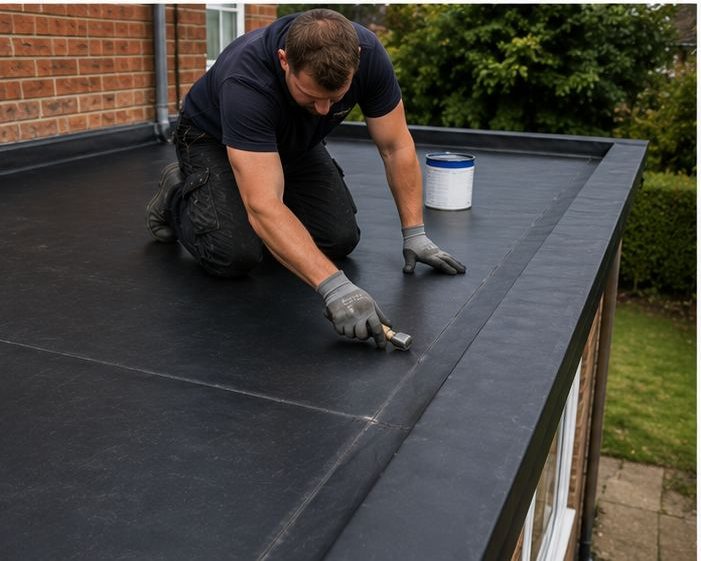
EPDM, by contrast, is manufactured and typically installed as a single sheet, dramatically reducing the number of joints on the finished roof. Fewer joints generally means fewer potential failure points, and the rubber itself remains flexible across a wide temperature range rather than stiffening and cracking the way older felt can with age. For an extension roof that is likely to be walked over occasionally, or that experiences movement as the extension settles, that flexibility is a genuine practical advantage.
Longevity is often the deciding factor for Eastville homeowners comparing the two. Felt roofing often needs replacement or significant repair within around 10 to 15 years, whereas EPDM is commonly guaranteed for 20 years or more when installed correctly, which can make it the more cost-effective choice once the full lifespan of the roof is taken into account rather than just the upfront installation price.
Installation speed and disruption are also worth weighing up. Because EPDM typically arrives as large, pre-cut sheets rather than being built up layer by layer on site, a competent installation on a typical Eastville extension roof can often be completed in less time than an equivalent felt job, meaning less disruption to the household and less time spent with the roof partially open to the elements while work is in progress.
Appearance is a secondary but real consideration, particularly on an extension roof that may be visible from upstairs windows or neighbouring properties. EPDM typically gives a smoother, more uniform finish without the visible overlaps that felt can show, which some Eastville homeowners prefer for a roof that forms part of the overall look of the property.
That said, felt still has its place, and a well-installed, well-maintained felt roof can perform adequately for a good number of years, particularly on smaller or less exposed extensions. The right choice depends on the specific roof, budget, and how long you want the covering to last before needing attention again.
For an existing extension roof that is due for re-covering, it is also worth having the deck checked before assuming which material to use, since any hidden decay in the timber structure will need addressing regardless of whether EPDM or felt is chosen. Brunel Roofing Bristol can talk through both options for your Eastville extension, assess the existing roof, and recommend the covering best suited to your particular property.
Get a Free Quote for EPDM Roofing in Eastville
Every roof is different — the fastest way to get an accurate answer is a quick chat with our team.