
Parapet walls are a defining feature of many Hotwells terraces, giving buildings their crisp, flat-fronted profile while concealing the flat or low-pitched roofs behind them. While they look smart from the street, parapet walls also introduce one of the more demanding detailing challenges in flat roofing, since the roof has to be waterproofed not just across its surface but also up and over, or behind, the parapet itself.
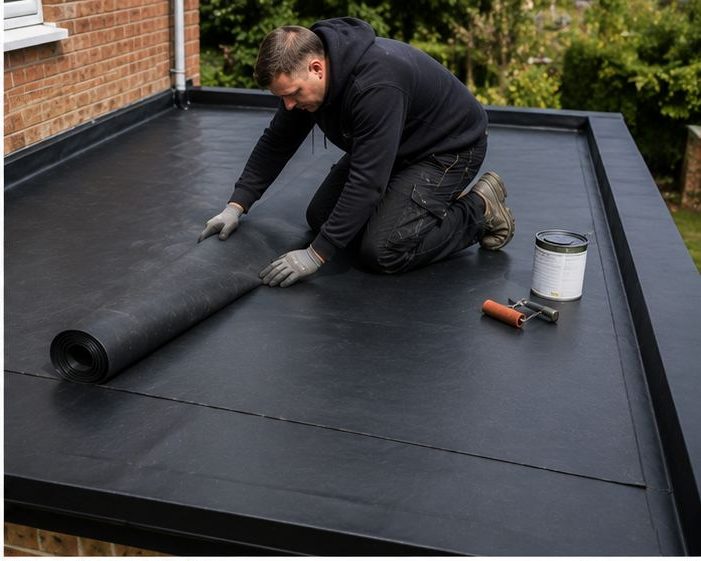
With an EPDM roof running up to a parapet wall, the membrane typically needs to be dressed up the inside face of the parapet to a suitable height above the roof surface, forming a continuous upstand that stops water reaching the top of the wall in the first place. This upstand height is not arbitrary; it needs to be sufficient to cope with wind-driven rain and any water that might build up temporarily during a heavy downpour before it drains away.
The top of a parapet wall, known as the coping, presents its own separate challenge. Even with a well-detailed upstand below, water landing directly on the coping stones or capping needs to be shed away from the wall rather than allowed to soak down through mortar joints and into the wall structure itself. On many older Hotwells parapets, deteriorated coping or failed pointing is actually a bigger source of damp problems than the flat roof membrane below it, which is why both need to be looked at together.
Where a parapet has a lead or metal capping, the EPDM membrane's upstand typically needs to be dressed to work with that capping so that the two elements combine into a single, continuous barrier against water. Gaps or poor overlaps between the membrane and the capping are a common failure point on older installations, allowing water to bypass the rubber entirely and track down inside the wall.
Corners are, once again, one of the trickiest parts of parapet detailing, since an internal or external corner in a parapet wall requires the membrane to be formed carefully to maintain a continuous, unbroken seal. On a typical Hotwells terrace with a rectangular rear roof enclosed by parapets on multiple sides, there can be several such corners to get right within a relatively small roof area.
Drainage also needs particular thought on a parapet-enclosed roof, since unlike a roof with open eaves, water cannot simply run off the edge. Outlets, gullies or scuppers through the parapet wall need to be correctly positioned and sized to clear water efficiently, and kept clear of debris, since a blocked outlet on an enclosed parapet roof can quickly lead to standing water building up against the upstands.
Given how much can affect a parapet roof's performance beyond the membrane itself, from coping condition to outlet placement, this is not an area where shortcuts pay off. A properly detailed EPDM installation around a Hotwells parapet should give years of reliable performance, but it does depend on getting every one of these details right.
If you have a parapet-walled flat roof in Hotwells that is showing signs of water ingress, Brunel Roofing Bristol can assess the whole system, from the coping down to the outlets, and recommend the right combination of repair or replacement to resolve it properly.
Get a Free Quote for EPDM Roofing in Hotwells
Every roof is different — the fastest way to get an accurate answer is a quick chat with our team.