
When people think about a flat roof, attention naturally goes to the main expanse of membrane covering the majority of the surface. In practice, though, the edges of an EPDM roof are just as important to how well it performs, and in an exposed location like Portishead, where wind coming off the Severn Estuary can be considerably stronger than in more sheltered parts of the city, the detailing at those edges can make or break a roof's long-term performance.
The edge of a flat roof is where the membrane terminates, typically against a trim, a fascia, a gravel edge, or an upstand. This is one of the most physically stressed parts of any flat roof, because it is where wind uplift forces concentrate most strongly. A gust hitting a flat roof does not press evenly across the whole surface; it tends to create the greatest lifting force right at the perimeter, which is exactly why edge detailing is treated as a critical part of any EPDM installation rather than an afterthought.
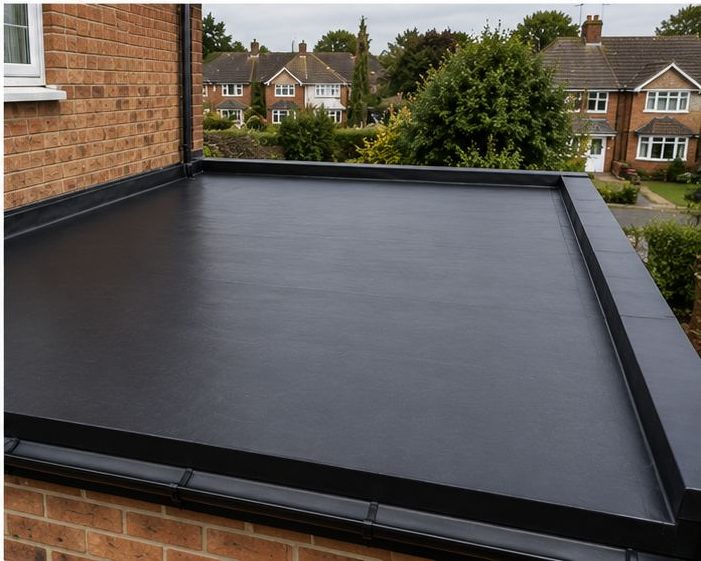
In a location as exposed as Portishead, this matters more than it might in a sheltered inland garden. A trim that is adequately fixed and properly detailed will hold the membrane securely against sustained wind loading over many years. A trim that has been fitted with less care, perhaps under-fixed, poorly sealed, or using the wrong profile for the situation, can allow the wind to start working its way underneath the membrane at the edge, and once that happens, it tends to get worse rather than better over time.
Beyond wind resistance, edges are also where water is most likely to find a way in if something is not quite right. A membrane that is dressed correctly over an edge trim sheds water cleanly, but any gap, however small, at a termination point can let rain track back underneath the roof covering, especially during the kind of driving, wind-blown rain that Portishead properties see more often than most.
This is one of the reasons a proper EPDM installation pays close attention to edge trims, fixing centres, and how the membrane is mechanically secured or adhered right at the perimeter, rather than just relying on the membrane's own weight and adhesive to hold it in place. On more exposed elevations, additional fixing or a heavier duty trim specification is sometimes the right call, and that decision should come from an assessment of the specific roof rather than a generic approach applied everywhere.
Homeowners in Portishead considering an EPDM roof, whether for a garage, an extension, or a dormer, are right to ask how the edges will be finished and secured, particularly if the roof faces the prevailing wind or sits in a genuinely exposed spot. It is a fair question, and a roofer who takes coastal exposure seriously should be able to explain exactly what they plan to do differently as a result.
Good edge detailing does not need to be complicated, but it does need to be done properly and matched to how exposed a particular roof actually is. Getting it right at installation avoids the far more disruptive scenario of a membrane lifting or leaking at the perimeter a few years down the line.
If you have an EPDM roof in Portishead, or are planning a new one, and want the edge detailing assessed properly for your property's level of exposure, Brunel Roofing Bristol can inspect the roof and advise on what is genuinely needed to keep it secure.
Get a Free Quote for EPDM Roofing in Portishead
Every roof is different — the fastest way to get an accurate answer is a quick chat with our team.