
St Pauls is built up of tightly packed Victorian and Georgian terraces and period townhouses, many with chimney stacks, bay roofs and party walls set hard against one another, and the streetscape has a real sense of character partly because of that variety. That kind of dense, closely built roofline means a roof rarely consists of a single unbroken slope. Instead it is made up of a series of junctions, and it is at these junctions that a roof covering alone cannot keep water out, which is where lead flashing comes in.
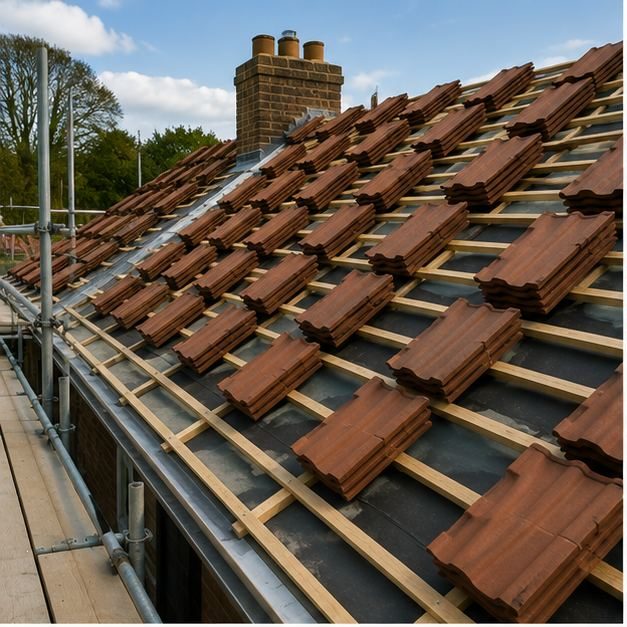
On a typical St Pauls property, flashing is needed wherever the roof meets a chimney stack, wherever a slope butts up against a taller neighbouring wall, along any valley where two roof pitches meet, and around dormers, bay roofs or box gutters where several surfaces come together. Each of these spots needs a purpose-shaped piece of lead dressed carefully into the brickwork, timber or adjoining slope to close the gap completely, and no two junctions on an older property are ever quite identical.
Lead remains the material most roofers reach for on this kind of work because it can be dressed by hand into almost any shape, moves with the roof through seasonal temperature changes without splitting, and, when installed well, lasts for decades rather than years. There are lighter modern alternatives on the market, and they have their place on certain jobs, but few match lead's combination of durability and workability on the varied and sometimes awkward junctions found on St Pauls's older roofs, where standard off-the-shelf shapes rarely fit.
When Brunel Roofing Bristol installs a new roof in St Pauls, the leadwork is planned alongside the tiling or slating rather than treated as an afterthought once the main covering is finished. Chimneys are fitted with soakers and cover flashing, abutments receive stepped flashing let into the mortar joints, and valleys are lined before the surrounding tiles or slates go on, so the whole roof behaves as one continuous, weatherproof system rather than a patchwork of separate repairs bolted together over time.
It's also worth remembering that flashing is not a one-off fitting that never needs thought again. As part of specifying a new roof, we consider how each piece of leadwork will age alongside the tiles or slates around it, so that the whole installation reaches the end of its serviceable life at roughly the same time rather than the flashing failing decades before the rest of the covering needs attention.
Getting this detail right at the point of installation is far more cost-effective than chasing leaks once a roof is finished, and it is one of the main reasons a full re-roof tends to outlast repeated patch repairs on a property in this part of Bristol. If you are planning a new roof in St Pauls and want the leadwork specified properly from the outset, Brunel Roofing Bristol can talk you through exactly what your property will need.
Get a Free Quote for New Roof Installations in St Pauls
Every roof is different — the fastest way to get an accurate answer is a quick chat with our team.