
Many flat roof extensions and dormers in Henleaze sit directly beneath or against an existing pitched roof, whether that's a single-storey rear extension built up against the main house wall or a dormer window set into a sloping roofline. Getting the junction between the new EPDM roofing and the existing pitched roof right is one of the most important parts of the whole job. Getting this detail right is not always straightforward on an older property.
This junction matters because it's where two different roofing systems, and often two different materials such as rubber membrane and roof tiles or slates, need to work together to keep water out. It's also typically the point where a much larger area of pitched roof drains down onto a comparatively small flat section, so the volume of water passing through this junction during heavy rain can be significant and needs to be planned for properly.
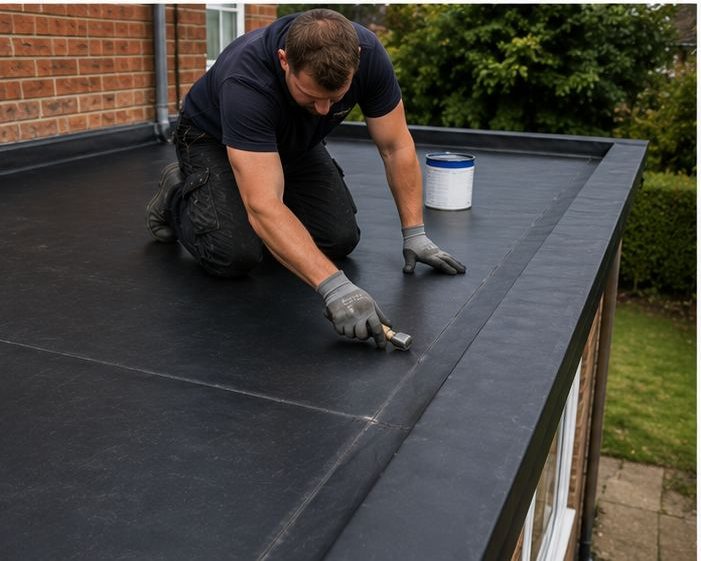
The standard approach involves dressing the EPDM membrane up the wall or under the edge of the existing pitched covering, with a properly formed flashing detail, often lead or a compatible material, that's tucked beneath the tiles or slates above. This allows water running down the pitched roof to pass over the top of the flashing and onto the flat roof surface, rather than finding a gap and getting behind the new membrane where it would go unnoticed.
The height to which the membrane is dressed up at this junction matters more than it might seem. An upstand that's too shallow risks water being driven back over the top during heavy or wind-driven rain, which isn't unusual in this part of Bristol, so getting this measurement right is a fundamental part of a durable junction that will still be performing properly many years from now. This is one of the details most likely to be under-specified on a lower-cost installation, and it's also one of the hardest to correct after the roof is finished.
Where a large area of pitched roof drains onto a smaller flat section, as is common with rear extensions built beneath a main roof slope, the drainage capacity at this junction needs proper consideration. Undersized guttering or valleys at this point can be quickly overwhelmed in heavy rain, so the volume of water involved needs to be accounted for at the design stage rather than as an afterthought.
Getting the sequence of work right matters too. Flashings, membrane and any tile or slate detailing need to be installed in the correct order so that water is always directed outward and downward at every stage, rather than being trapped or redirected into a gap between materials.
Junctions like these come up regularly on the older, characterful properties around Henleaze, and Brunel Roofing Bristol pays particular attention to getting this detail right, since a poorly formed junction between a flat and pitched roof is one of the most common sources of a persistent, hard-to-trace leak. Getting it wrong doesn't always show up immediately either, which is part of why this junction deserves particular scrutiny during any inspection or quotation visit.
If you're planning a flat roof extension or dormer that needs to tie into an existing pitched roof in Henleaze, Brunel Roofing Bristol can design and install this junction properly, and provide a quotation for the work involved.
Get a Free Quote for EPDM Roofing in Henleaze
Every roof is different — the fastest way to get an accurate answer is a quick chat with our team.