
Not every roof in Lawrence Weston needs replacing in full. Sometimes a homeowner wants a new covering over the main house while a newer extension roof stays as it is, or a partial repair leaves an older section of tiling that a new roof has to tie into cleanly. Joining new roofing work to an existing section is one of the more skilled parts of the job, and it is where a rushed or inexperienced approach tends to show up first, often within a single winter of poor weather.
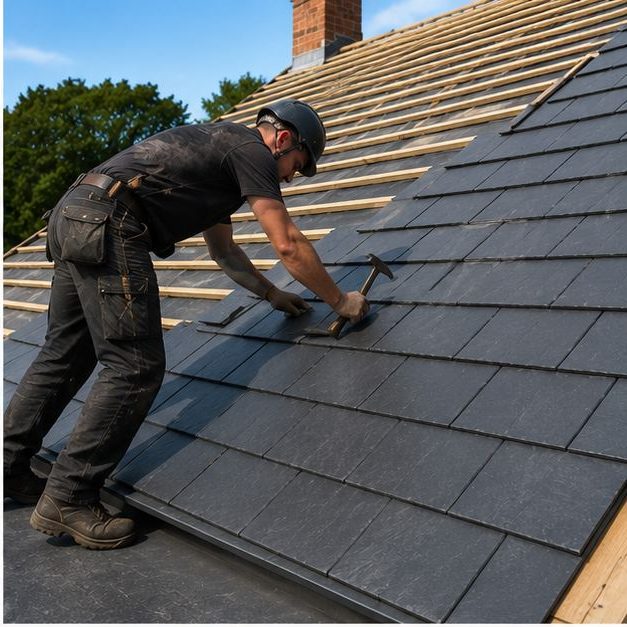
The starting point is matching the setting out of the new tiles or slates to the gauge of the existing coursing, so that horizontal lines run through cleanly rather than stepping awkwardly at the join. Battens need to be positioned at the correct spacing to continue this pattern across the transition, and the overlap between old and new coverings has to be generous enough to shed water reliably in heavy rain rather than relying on sealant or mastic to cover a gap that was never quite closed properly.
Where a new roof section meets an existing one at a wall, ridge or abutment, flashing details matter more than the tiles themselves. Lead or an equivalent flashing material needs to be dressed properly into the join, tucked under the new covering and lapped over the old in the right sequence, so that water is always directed onto a surface below rather than finding a way in at the seam. This sequencing, working from the bottom of the roof upward so each course overlaps the one beneath, is what keeps the whole junction watertight even in driving rain.
On the many semi-detached and terraced properties around Lawrence Weston, this kind of junction work is common wherever one owner has extended and the neighbouring roof has not, or where a rear addition sits at a different level to the main roofline. Getting the underlay to run through continuously beneath the join, rather than stopping short and relying on the tiles alone, is another detail that is easy to overlook but makes a real difference to how well the roof performs over time.
Fixings also deserve attention at a join. Tiles or slates near the edge of a new section are more exposed to wind uplift than those in the middle of a roof slope, so additional nails, clips or ties are often needed around the perimeter of the new work to keep everything secure, particularly on properties that sit a little more exposed towards the edges of the estate.
If you have a roof with a mix of older and newer sections and are not sure how they should be brought together, Brunel Roofing Bristol can look at the whole roof as one system and advise on the cleanest way to join everything up, whether that means a partial repair or a fuller replacement. Contact us for a quote and a clear explanation of what your property needs.
Get a Free Quote for New Roof Installations in Lawrence Weston
Every roof is different — the fastest way to get an accurate answer is a quick chat with our team.