
Flat roof leaks rarely have one single cause, and Barton Hill's mix of older terraced properties and more recent rear extensions means the reasons a roof starts letting water in can vary quite a bit from house to house. Understanding the common culprits helps make sense of what a proper inspection is actually looking for.
Failed seams and joints are among the most frequent causes, particularly on older felt roofs made up of multiple bonded layers. Each seam is a potential weak point, and as the material ages and goes through repeated cycles of heat and cold, these joints can lift, crack, or separate, letting water in gradually rather than all at once, which is why a leak often seems to appear out of nowhere.
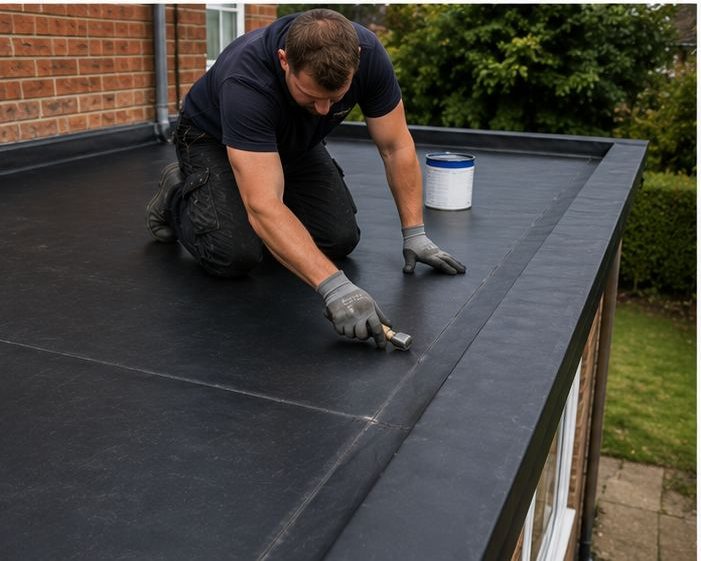
Damaged or poorly maintained flashing around chimneys, walls, and roof edges is another very common cause on Barton Hill's older properties. Flashing is designed to seal the junction between a flat roof and an adjoining vertical surface, and if it has come loose, corroded, or was never properly detailed in the first place, water can track in at exactly these transition points even when the main roof covering itself is in reasonable condition.
Standing water that fails to drain is a less obvious but equally significant cause. Flat roofs rely on a slight built-in fall to guide rainwater toward outlets, and if that fall has been compromised, whether by a sagging deck, settled insulation, or simply an original design fault, water can sit for extended periods in low spots. That sustained pooling puts continuous pressure on the covering in one specific area and often leads to failure there well before the rest of the roof shows any wear.
Blocked or poorly maintained outlets and gutters contribute to the same problem from another angle. Leaves and debris collecting around drainage points on Barton Hill roofs, particularly those near mature trees, can cause water to back up rather than draining away, again increasing the chance of ponding and eventual leaks.
General age and material degradation is simply a factor too. Older felt roofs in particular become more brittle over time as UV exposure and weather cycling take their toll, and once the surface starts cracking, water finds a way in through even hairline splits that widen with each freeze-thaw cycle.
Occasionally, the underlying cause is not the covering at all but the deck beneath it. A leak that has been present for a while, even a small one, can allow damp to spread into the timber decking, and once that happens, surface repairs alone will not solve the problem until the affected decking is addressed directly.
It is also worth noting that the point where water actually appears inside a property is not always directly above the source of the leak on the roof. Water can travel sideways along a roof deck or down a wall before finding its way through a ceiling, which is another reason a proper inspection of the whole roof, rather than just the area directly above the visible damp patch, is so important.
Because leaks can stem from so many different sources, a proper inspection that checks the seams, flashings, drainage, and decking together is really the only way to identify the actual cause rather than guessing. Brunel Roofing Bristol carries out this kind of thorough assessment on flat roofs across Barton Hill and can advise on the right fix once the real cause is understood.
Get a Free Quote for EPDM Roofing in Barton Hill
Every roof is different — the fastest way to get an accurate answer is a quick chat with our team.