
Moss on a roof rarely stays exactly where it grows. As it thickens and ages, clumps of moss dry out, loosen, and eventually break away, often sliding down the roof slope during heavy rain or strong wind. For Ridgeway homeowners, the first sign of a moss problem is sometimes not the roof itself but a gutter that has started overflowing or backing up.
Once dislodged moss reaches the gutter, it does not simply wash through and disappear. Moss holds water like a sponge, and combined with grit, sand from tile surfaces, and general roof debris, it forms a dense sludge that settles at the bottom of the gutter run. Left alone, this builds up over successive rainfalls until the gutter channel is partially or fully blocked.
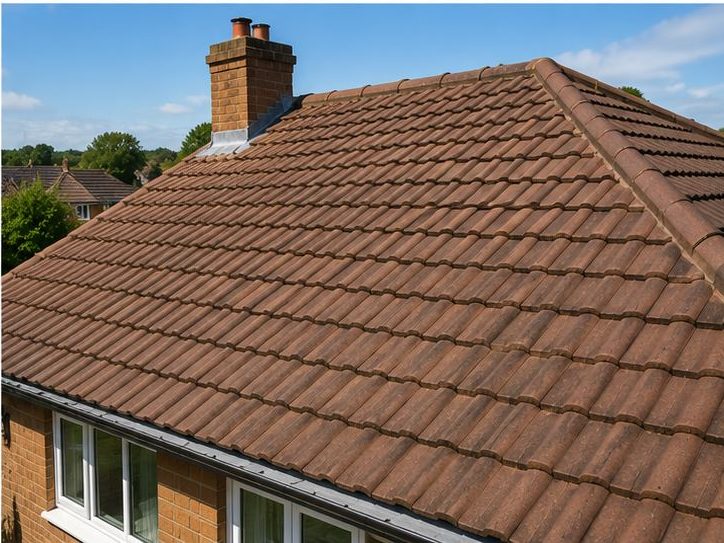
A blocked gutter causes problems well beyond the gutter itself. Water that cannot flow away freely will overflow at the nearest low point, often running down the exterior wall, pooling near the foundations, or finding its way behind fascia boards and into the roofline timber. On properties across Ridgeway with traditional guttering and downpipes, this kind of overflow can go unnoticed for a surprising length of time, since it often only shows itself clearly during a heavy downpour.
Cast iron guttering, still found on a number of older Ridgeway properties, is particularly prone to problems from trapped moss and standing water, since prolonged dampness sitting in a blocked section can accelerate rusting and corrosion over time. Modern uPVC guttering is more resistant to this specific issue but can still suffer from joints working loose under the weight of a persistent blockage, so the underlying cause on the roof is worth addressing regardless of gutter material.
Downpipes suffer too. Moss debris that does make it past the gutter can settle further down the system, gradually narrowing or completely blocking downpipes at bends and joints. Once that happens, water has nowhere to go except back up and over the gutter edge, which defeats the purpose of the drainage system entirely.
It is a cycle worth breaking early. The longer moss is left to grow and shed on a roof, the more material ends up in the gutters, and the more frequently those gutters need clearing out just to keep water moving as intended. Regular roof cleaning interrupts that cycle at the source, rather than treating the gutter symptoms while leaving the moss on the roof to keep producing more debris.
When we clean a roof in Ridgeway, we are also mindful of what happens to the moss and debris we remove, and we can check the gutters as part of the same visit to see whether they need clearing too. It is a more sensible approach than dealing with the roof and the gutters as two unrelated problems, when in practice one is very often causing the other.
Standing water caused by a blocked gutter can also create its own secondary problems around a Ridgeway property, from damp patches appearing on interior ceilings near the roofline to soil erosion where overflow repeatedly hits the same spot of ground below. What begins as a small amount of moss shedding from the roof can, over a season or two, escalate into a genuinely disruptive maintenance issue if the source on the roof itself is never addressed.
If your gutters have been overflowing more than usual, it may be worth having your roof looked at rather than just the gutters cleared. Contact Brunel Roofing Bristol for an assessment of both.
Get a Free Quote for Roof Cleaning in Ridgeway
Every roof is different — the fastest way to get an accurate answer is a quick chat with our team.