
Where a chimney stack meets the roof slope is one of the most leak-prone junctions on any house, and it's lead flashing — along with the soakers and back gutter tucked in around the base of the stack — that does the job of keeping that junction watertight. On a fair number of Greenbank's older terraces, this lead has been sitting in place for decades, quietly doing its job until age, movement, or a storm finally catches it out and a leak appears somewhere inside the house, often in a room that gives little clue as to where the actual problem lies.
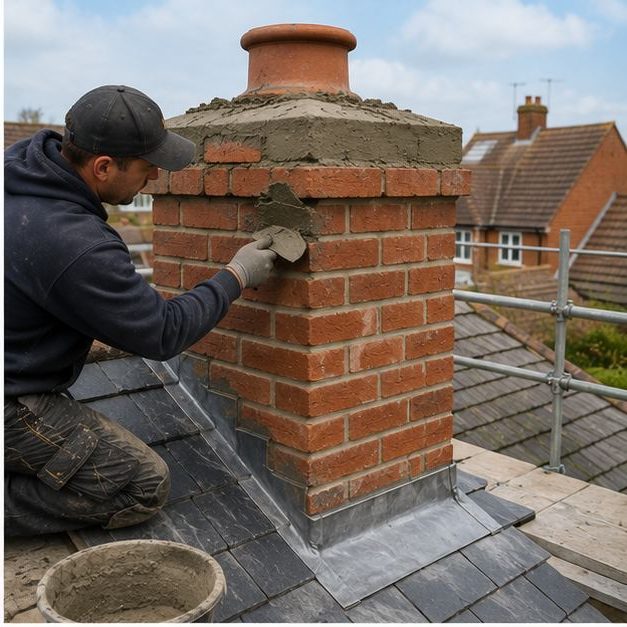
Flashing typically fails in one of a few ways: the lead itself splits or cracks as it fatigues from years of thermal expansion and contraction, it lifts away from the mortar joint it was originally dressed into, or the joint between flashing and brickwork opens up as the mortar around it weathers. Corrosion and general thinning of the lead can also play a part on particularly old installations, especially where run-off from other parts of the roof has been passing over the same section for years. None of these are always obvious from the ground, which is part of why chimney leaks can go unnoticed for a while before a stain finally appears on a ceiling or in a loft, sometimes long after the actual defect first developed.
One thing worth understanding is that water doesn't always show up directly below where it's actually entering. It can travel along a rafter or run down the inside face of a chimney breast before dripping somewhere else entirely, so a leak that appears in a bedroom ceiling might well trace back to flashing on the opposite side of the stack. Proper investigation, rather than guesswork, is what actually resolves the problem rather than just patching the symptom nearest the visible stain, which can mean the same leak reappearing again the following winter.
Repairs can range from re-dressing and resealing existing lead that's still in reasonably good condition, to a full strip-out and replacement using new code lead cut and dressed to the stack's actual dimensions, rather than a generic off-the-shelf fix that doesn't quite fit the profile of the roof. Soakers — the small individual pieces of lead woven between roof tiles at the sides of the stack — and the back gutter above the chimney are just as important as the visible flashing at the front, and are often the parts most overlooked during a quick repair, only for the leak to reappear from a slightly different spot a year or two later.
Because this work sits at roof height on Greenbank's terraced houses, safe access matters as much as the repair itself, and it's not a job that lends itself to shortcuts from a ladder propped against the guttering. Proper scaffolding also allows a thorough check of the surrounding brickwork and tiling while the access is already in place, which can save a second visit if any other issues are found during that inspection.
If you've spotted a damp patch that seems to line up with your chimney, or simply want ageing flashing checked before it becomes a problem, Brunel Roofing Bristol can carry out a free inspection and set out exactly what's needed to put it right, with a 15-year guarantee on any work carried out.
Get a Free Quote for Chimney Repairs in Greenbank
Every chimney is different — the fastest way to get an accurate answer is a quick chat with our team.