
It's easy to look at crumbling mortar on a chimney and assume it's a cosmetic issue that can wait. In practice, failed pointing is one of the more consequential problems a chimney can develop, because of everything it sets in motion once water starts finding its way through gaps that mortar is supposed to seal.
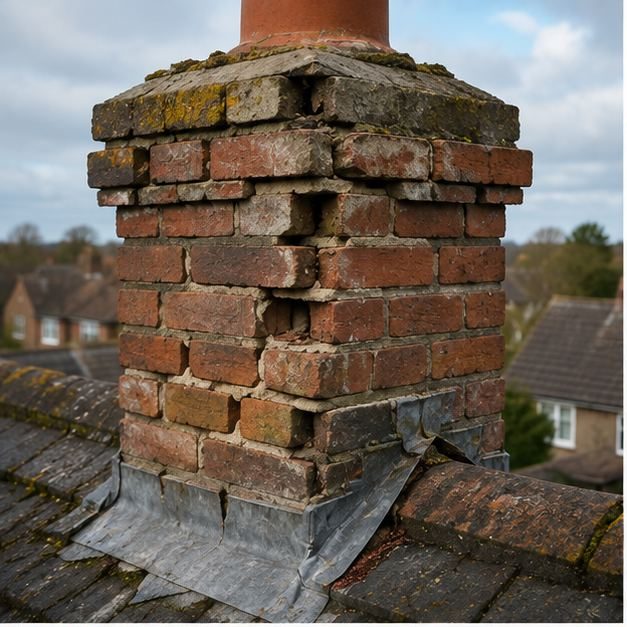
Mortar joints aren't just filler between bricks, they're a sacrificial layer designed to weather and be renewed periodically, protecting the bricks themselves from taking the brunt of wind and rain. When pointing fails, that protection disappears, and water that would have run off a sound joint instead soaks directly into the brick faces on either side. Over successive winters, that moisture freezes and expands within the brick, which is how spalling begins.
Beyond the brickwork itself, failed pointing lets water penetrate deeper into the stack's core, sometimes reaching the flue lining or tracking down internally to appear as damp patches on chimney breasts inside the house. This is a common pattern on the older terraced properties found across Barton Hill, where mortar that's been slowly failing for years can suddenly show up as an indoor problem once it reaches a critical point.
Left unaddressed long enough, deteriorating mortar contributes to loose brickwork and, eventually, structural instability in the stack, turning what would have been a straightforward repointing job into a partial or full rebuild. The cost difference between catching it early and catching it late is usually significant, which is why mortar condition is one of the first things worth checking on any chimney that hasn't been looked at in a while.
It's worth mentioning a common homeowner mistake here too: patching visible gaps with a generic exterior sealant or filler rather than proper mortar. It might look tidy for a while, but it doesn't bond or weather the same way as mortar, tends to crack away within a season, and can make the eventual proper repointing job messier by leaving residue that has to be cleaned off first. There's no fixed interval at which mortar simply must be renewed, since it depends heavily on exposure, mortar type and original workmanship, but it's fair to say a sound repointing job on an older stack is generally expected to last a good number of decades rather than needing attention every few years. If a chimney is showing failure well before that, it's often worth checking whether the original mortar mix or application was right for the property in the first place. Keeping an eye on mortar condition doesn't need to be complicated, a glance from the garden every so often, particularly after a hard winter, is usually enough to notice when joints start looking noticeably more recessed than they used to.
If your chimney's pointing is looking recessed, crumbly or cracked, it's worth having it assessed before the next round of wet weather does further damage. We carry out free inspections across Barton Hill and repoint using mortar matched to the age and construction of the property, with a 15-year guarantee on the finished work.
Get a Free Quote for Chimney Repairs in Barton Hill
Every chimney is different — the fastest way to get an accurate answer is a quick chat with our team.