
Once a chimney's flashing starts to fail, the question isn't usually whether it needs attention, but whether the existing lead can be repaired in place or whether the whole run needs replacing. That decision depends on a few factors worth understanding before assuming the more expensive option is automatically necessary.
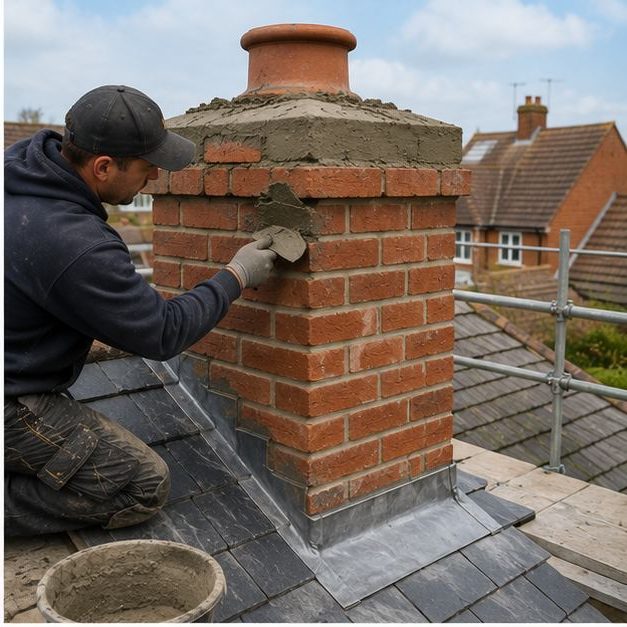
Localised repair makes sense where the lead itself is fundamentally sound but has come loose at a specific point, typically where the mortar joint it was dressed into has weathered out and let the flashing lift away from the brickwork. Re-dressing that section into a freshly raked joint, sometimes with lead wedges or clips to hold it securely, can resolve the leak without disturbing flashing elsewhere on the stack.
Full replacement becomes the sensible choice where the lead has split in multiple places, where corrosion has thinned the metal significantly, or where the flashing is old enough that fixing one section is likely to be followed by another failure elsewhere within a year or two. Lead does have a long working life, but on some of the older properties in Barton Hill, flashing that's original to the building has often reached, or passed, the point where patching is a false economy.
There's also a practical consideration around access. If scaffolding is already needed to reach the chimney for another reason, replacing flashing that's showing early signs of wear at the same time can make more sense than paying for access twice, once now for a repair and again in a few years for the inevitable replacement.
Cost is naturally part of the decision too, and while a repair is nearly always cheaper upfront than a full replacement, that comparison should account for how long each is likely to last. A repair to lead that's otherwise nearing the end of its working life may need revisiting again fairly soon, whereas a full replacement, while a bigger job initially, resets that clock across the whole run. Assessing which category a chimney falls into means physically checking the lead rather than judging it from the ground: looking for where it's still firmly dressed into the brickwork versus where it's lifted, checking the metal itself for splits or thinning, and examining the joints between sections for gaps. This close inspection is really the only way to give an honest answer, since flashing that looks fine from a distance can be failing at a specific joint that's simply not visible from below. Whichever route is taken, it's worth asking for an explanation of why that option was recommended for your specific chimney, rather than accepting a generic answer, since the right choice genuinely does depend on the condition of the lead in front of the person assessing it.
The right call depends on what's actually happening with your specific flashing, which isn't always obvious from ground level. We inspect chimneys across Barton Hill for free and give an honest recommendation on repair versus replacement, rather than defaulting to the larger job.
Get a Free Quote for Chimney Repairs in Barton Hill
Every chimney is different — the fastest way to get an accurate answer is a quick chat with our team.