
Windy edges are hard on mortar. If yours is failing, a dry verge can often be added without re-roofing. Here is what decides whether that is possible.
The mortar along a gable end takes a battering on exposed ground, and Bromley Heath has plenty of it. Homeowners often ask whether a dry verge can be fitted to the roof they already have, or whether the whole covering has to change first. The answer depends on a few checks. This is what we look at before saying yes or no.
The short answer
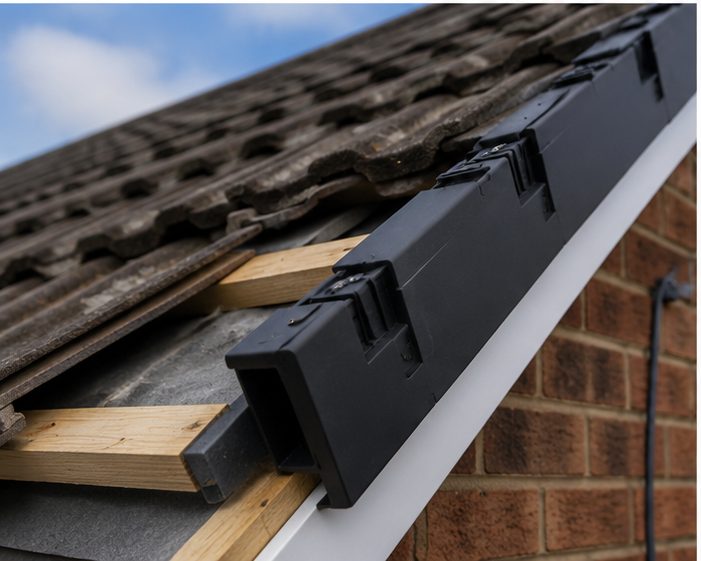
Often, yes. Where the roof covering is basically sound and the mortar edge is the part that has failed, a dry verge can replace the mortar without re-roofing. The old bedding and loose end tiles are removed, the edge made good and the verge units fixed in place. It is a repair that upgrades the edge. We still check everything first, because the edge is only one part of the picture.
Compatibility with your tiles
The big question is the tile profile. Dry verge units are made for particular tile shapes, and the system must match yours. Later 20th-century concrete tiles are often straightforward, but some older or unusual tiles are not. We confirm this on site rather than by guesswork, because the wrong match will not seal or fix properly. Newer estate roofs usually pose few problems, while cottage roofs call for more care.
- Tile profile and a matching system
- Condition of the tiles at the edge
- Soundness of the timbers beneath
- Straightness of the gable wall
Condition of the roof edge
We look for tiles that have shifted, cracked end tiles, damp stains near the gable wall and mortar on paths below. If the timbers under the verge are rotten or the wall is out of true, they have to be dealt with first. Fixings need something sound to hold onto, especially in strong winds. Being thorough here avoids fitting something that will not hold.
How it is fitted
Failed mortar is cleared, then the tile ends are checked and replaced where necessary. Verge units go on, along with cap and tile-end pieces, fixed to the tile maker's guidance. There is no wet mortar involved, so the work is quick and clean and the edge is secure straight away. The finished edge is neat and tidy, with no mess left on the drive.
When a re-roof is the better plan
A dry verge is not a cure for a roof failing elsewhere. If the tiles are crumbling, the felt is tired or the battens are weak, fitting a new edge to an old covering is poor value. In that case we suggest a re-roof, with a dry verge as part of it, and explain why. The edge is only as good as the roof it finishes.
Frequently Asked Questions
Can a dry verge be fitted to a very old roof?
Sometimes, but old or irregular tiles may not suit a standard system. We assess the tiles and the edge on site and advise on an alternative if a dry verge is not suitable. Cottage roofs often need extra checks.
Will the work disturb the rest of the roof?
Only the edge is touched. We remove loose tiles and old bedding at the verge and leave the rest alone, unless we find other faults that you should know about. You see what we find.
How do I know a dry verge is the right repair?
If the mortar has failed and the tiles are sound, it is a strong option. We explain what we see, what the alternatives are and why we would suggest one, so you can decide with confidence. The decision stays with you.
Talk to our team about dry verge systems in Bromley Heath
Every roof is different — the fastest way to get an accurate answer is a quick chat with our team.