
A gable end is the first thing you see when you look at the side of a house. Here is how a dry verge alters its appearance and what it does for the roof edge.
The verge is the roof edge at a gable end, and on houses with open, windy edges like those in Bromley Heath it is highly visible. A worn mortar verge, with cracks, stains and loose tiles, drags down the whole elevation. A dry verge changes that appearance and the way the edge performs. Here is what you can expect to see.
What an old mortar verge looks like
Over time mortar fades, cracks and sometimes drops, leaving a ragged line and gaps. Moss and staining collect in it. Tiles at the edge may sit unevenly, and the colour often differs from the roof, since it has aged differently. On later 20th-century homes the effect is common, and on a prominent gable it stands out. The difference is noticeable from the road.
What changes with a dry verge
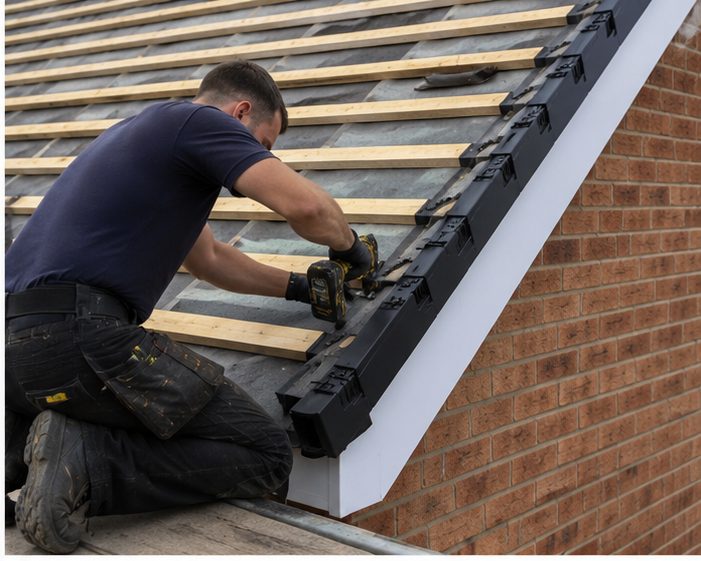
The dry verge system replaces the mortar with fixed units that run in a straight, even line along the edge. Colour and shape are consistent from one end to the other. There is no bedding to discolour, so the edge stays crisp, and the cap pieces finish the ridge and corners neatly. The line is crisp from the bottom tile to the ridge.
- Straight, uniform line along the roof edge
- Consistent colour with no mortar staining
- Neat finishing at the top and bottom
- Tile ends tidied and held secure
The practical side of a cleaner edge
The look is a by-product of function. Because the units are mechanically fixed, they resist wind lift at the edge, which matters on open ground. There is nothing to crumble onto paths or drives, and the closed edge stops weather, birds and insects getting under the tiles. The tidy appearance simply lasts. Less cleaning and fewer repairs mean the gable keeps its smart look.
What it will not change
A dry verge does not alter the roof's colour, its tiles or the shape of the gable. It also does not hide a roof that is failing elsewhere. If the tiles are worn out, the new edge will make that more obvious. We tell you honestly if the covering needs more attention than the edge does. Looks improve, but the roof behind still needs to be sound.
Choosing the finish
Units come in a range of colours to suit different tile types, and the system is chosen to be compatible with your tiles, following the tile maker's guidance. We check on site that a suitable match exists, so the finished gable looks like it belongs to the house rather than being an add-on. The finish should look planned, not patched.
Frequently Asked Questions
Will a dry verge match my existing tiles?
Usually a suitable colour and profile can be found, but compatibility depends on the tile type. We check on site and tell you if a perfect match is not possible. We bring examples where we can.
Does a dry verge make a gable look modern?
It looks neat and uniform, which some people take as modern. On an older cottage we can discuss whether it suits the character of the house or whether a mortar repair is a better fit. A mortar repair keeps the traditional look.
Is it only about appearance?
No. Appearance is a benefit, but the real reasons are wind resistance at the edge and no mortar to crack and fall. Keeping weather and pests out matters as much as the finish. Both matter on exposed ground.
Talk to our team about dry verge systems in Bromley Heath
Every roof is different — the fastest way to get an accurate answer is a quick chat with our team.