
Replacing failed mortar with a dry verge does not require a new roof in most cases. It depends on the tiles and the state of the edge. This guide covers what we check on Pucklechurch roofs.
If mortar is dropping off the edge of a gable onto the drive or path, you have the typical first sign. Many owners assume a new roof is needed. Often it is not. A dry verge can usually be fitted to what is already there, provided a few things are right.
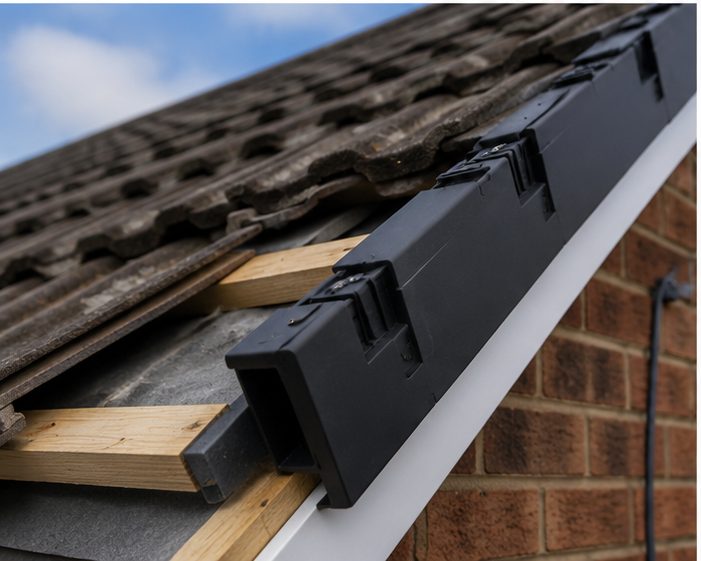
Start with the tile profile
Dry verge units are made for particular tile shapes and profiles. Some existing roofs match well, others do not. On a village cottage with old or unusual tiles, we may need to see the roof close up before saying yes. We check compatibility on site and tell you plainly.
On a village cottage the roof may have been worked on at different times by different hands, so one gable can differ from the other. We look at both before agreeing what to do, and we never assume that one side tells us about the rest.
How an existing roof is prepared
The old mortar and any loose or damaged tiles along the gable edge are taken off. We check the battens and felt close to the edge, repair what is weak and then fix the units and tile-end pieces mechanically, following the tile maker's guidance. The rest of the roof stays untouched.
If the units fit, the work is quicker and cleaner than most owners expect. If they do not, we explain why and suggest the next best way of finishing the edge, rather than forcing a part that will not sit properly. That honesty saves you paying for something that would not hold.
When it does not suit
A dry verge is not a cure for a roof failing elsewhere. If the main slope has slipped tiles, tired felt or ridge problems, we deal with those as well. Sometimes the answer is to repair the roof first and fit the verge later, or to keep the traditional mortar finish.
- Roof tiles with a profile that has no matching unit
- Damaged battens or rotten timber at the edge
- Widespread wear elsewhere on the roof
- Gable edges with unusual details or overhangs
What it gives you
With no mortar to crack, nothing drops onto the drive. The mechanically fixed units resist wind lifting at the edge, which matters on open country-edge plots. The closed edge also keeps out weather, birds and insects. It suits repairs, re-roofs and new roofs alike.
Before you agree to work
Ask for a written description of what will be removed, fitted and finished. It may need planning or Building Regulations checks — we advise before work starts. We take care to explain which tiles and parts will be used and whether both gables need doing or just the one.
We also check the bargeboard or wall under the verge while the edge is open. If water has been getting in behind failed mortar, damp timber is far easier to deal with now than after a new edge has hidden it. It is a small extra check that avoids a hidden problem.
Frequently Asked Questions
Can I have a dry verge on only one gable?
Yes. It is common to repair only the gable where the mortar has failed. We check each gable for tile profile and condition, since slopes can differ from one another, and we explain what we find before any work starts.
What is the first sign my verge has failed?
Pieces of mortar on paths, the drive or in gutters are the usual first sign. You may also see cracks or gaps along the roof edge from the ground. Ring us for a proper look and avoid going up yourself.
Does fitting a dry verge disturb the rest of the roof?
Not much. Work focuses on the edge of the roof along the gable. We take care of the neighbouring tiles and check them as we go, repairing or replacing any that are damaged. We explain it in simple terms.
Talk to our team about dry verge systems in Pucklechurch
Every roof is different — the fastest way to get an accurate answer is a quick chat with our team.