
People often say fascia when they mean soffit, or gutter when they mean both. Each is a separate part with a separate job. This is a plain guide to the roof edge on a Pucklechurch house.
Stand under the eaves of a village cottage and look up. Close to the wall you can see the underside of the roof overhang. At the front is a board, and clipped to it is a channel. Names matter when you are asking for a price or reading a description of work.
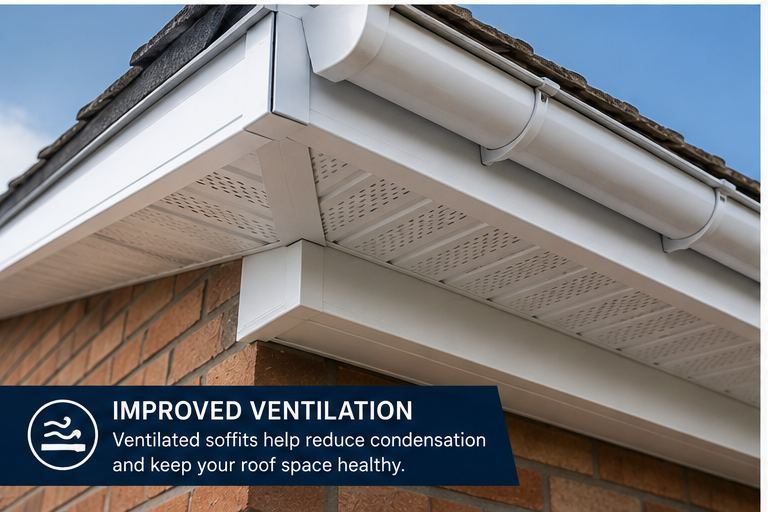
What the fascia does
The fascia is the board along the ends of the rafters, facing outwards. It is the visible front edge of the roof. It carries the gutter and protects the rafter ends from the weather. When it rots, the gutter loses its support and begins to sag or leak.
In older houses the fascia may be a thick, painted timber board, sometimes with a decorative edge. On later infill homes it is more often a plain, thin board, and on many it is already UPVC. The names differ, but the job of protecting the roof edge is the same.
What the soffit does
The soffit runs flat beneath the overhang, from the fascia back to the wall. It closes the gap so birds, insects and weather cannot get in. Vented versions or vent strips allow air into the roof space, helping timbers and insulation stay dry and keeping condensation down.
- Fascia: upright board that carries the gutter
- Soffit: flat board closing the underside of the eaves
- Gutter: channel that takes rain to the downpipe
- Bargeboard: board along the sloping edge of a gable
What the guttering does
Guttering catches rain from the roof and carries it to the downpipes and drains. If it leaks or overflows, water runs down the wall, stains the brick or stone and soaks the soffit and fascia. A blocked or misaligned gutter is one of the most common causes of damp in eaves timbers.
Downpipes finish the job by carrying water to the drain. If the pipe is blocked or leaking at a joint, the problem shows as damp on the wall, which can be mistaken for a roof or wall fault. Checking the downpipe is part of understanding any eaves problem.
Old houses, newer houses
Older stone and brick cottages often have timber boards of varying age and thickness, sometimes with uneven eaves. Later infill homes more often already have UPVC. Either way the three parts work as a group, and a problem in one tends to move to the next if it is left.
What to ask when quoting
Ask whether the work covers the fascia, the soffit, the gutter or all three, how rafter ends will be checked and how the roof space will be ventilated. Scaffold is normally needed. On older homes, we check what existing soffit boards are made of before disturbing them.
It is worth asking for the parts to be listed separately in any description of work, so you can see exactly what is being replaced and what is staying, and compare like with like. Clear descriptions make quotes far easier to compare.
Frequently Asked Questions
Is a bargeboard the same as a fascia?
They are close relatives. A fascia runs along the eaves, while a bargeboard follows the sloping edge of a gable. Both are boards that protect the roof timbers and are often replaced together. We can talk through which suits your house.
Why do my gutters overflow when they look clear?
The gutter may have lost its fall because the fascia has sagged or the brackets have loosened. Water then pools and spills over the edge. A check of the fascia and brackets usually shows the cause.
Can UPVC boards be painted?
Yes, the finish is wiped clean, not painted, which is why it is called very low maintenance. If you want a different look, finishes include white, darker colours and wood-effect, and we can talk through which suits your house.
Talk to our team about UPVC fascias and soffits in Pucklechurch
Every roof is different — the fastest way to get an accurate answer is a quick chat with our team.