
Mortar is the traditional finish at a gable edge, and a dry verge is the fixed alternative. Each has a place, but mortar's weakness is that it cracks, and dry verge's strength is that it does not.
The verge is the edge of the roof at a gable, and Downend has plenty of them, across Victorian terraces, inter-war semis and later estates. Traditionally the tiles there are bedded in mortar. Dry verge systems replace that with mechanical fixings. Which is better depends on the roof, though the trade-offs are clear enough. The answer is usually clear once the edge has been looked at.
How a mortar verge behaves
Mortar is hard, rigid and bonded on. The roof beneath moves a little with wind and temperature, and mortar does not. Cracks form, water gets in, frost and weather widen them and eventually pieces drop out. Falling crumbs on a path or drive are a typical first sign. On the right roof, a well-made mortar verge can still do a decent job. Frost, rain and years of movement all work against it.
How a dry verge behaves
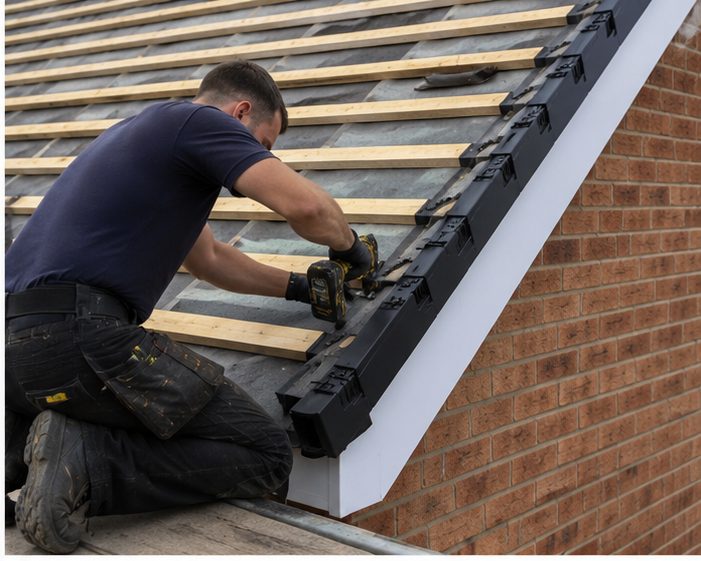
A dry verge uses verge units and tile-end or cap pieces that are mechanically fixed to the roof. There is no wet mortar to crack or fall. The edge keeps its line and weather resistance, wind has a firmer fixing to deal with, and birds and insects find fewer gaps to exploit. It is fixed to the tile maker's guidance. Nothing in the system depends on a bond that can fail.
Where each tends to suit
Dry verge suits new roofs, re-roofs and repairs where mortar has failed. Mortar may still suit some older roofs where appearance and matching existing work matter, and where the tile profile will not take dry units. Compatibility depends on the tile profile, which we check on site. The things that guide our advice include these: On a street of mixed roofs, neighbours may have different answers.
- The type and profile of the tiles
- The condition of the edge and battens
- Whether the mortar has already failed
- Exposure of the gable to wind
What neither one can do
Neither approach cures a roof failing elsewhere. A dry verge is not a fix for slipped tiles, worn felt or leaking flashings. Neither does a new verge matter much if the roof is near the end of its life. We look at the whole roof and tell you whether the edge is the real priority. A tidy edge is no use above a tired roof.
Making the choice
For most roofs that need the edge dealing with, we lean towards dry verge where it fits, because it removes the part that fails. Ask any roofer which units they will use, how they are fixed and what happens to the old mortar. Call us for a proper look and we will advise. The decision is yours; we simply give you the facts.
Frequently Asked Questions
Will a dry verge look different from mortar?
Slightly, since the verge pieces and caps are a manufactured finish, but they are made to sit neatly with the tiles. The line is often cleaner. We can explain how it will look on your roof. Colour and profile are matched to the tiles.
Can I swap mortar for dry verge on an existing roof?
Often yes, especially where the mortar has failed, provided the tile profile is compatible. We check on site and tell you plainly if the units will not fit. Do not assume either; the roof tells us.
Is mortar ever the better choice?
Where dry units do not suit the tiles, or where matching an older appearance matters, mortar may still be sensible. We explain the trade-off and let the roof decide. We say so plainly if mortar is the better route.
Talk to our team about dry verge systems in Downend
Every roof is different — the fastest way to get an accurate answer is a quick chat with our team.