
Both close the roof edge at a gable, but they behave very differently as the years pass. Here is a plain comparison for Nailsea roofs, which meet westerly weather head on.
The verge is the edge of a tiled roof where it stops at a gable wall. Traditionally it is sealed with mortar; a dry verge uses fixed units instead. For Nailsea's mainly post-war and later estate roofs, open to wind and rain from the west, the choice between them is worth thinking about before the old mortar fails.
How a mortar verge works
Mortar bedding holds the edge tiles in place and fills the gap between tiles and wall. It is a fine, traditional detail when freshly made, but it is rigid. The roof moves a little with heat and wind, the mortar cracks, and rain gets in behind it. Over time pieces drop out, often landing on paths and drives as the first sign.
Mortar also suffers from the way it is applied, as thin patches on a damp day cure badly and fail sooner than a well-made bed, so how and when it is done matters as much as the material. That is the main reason mortar edges need attention so regularly, and why more roofs are now finished with fixed dry units instead.
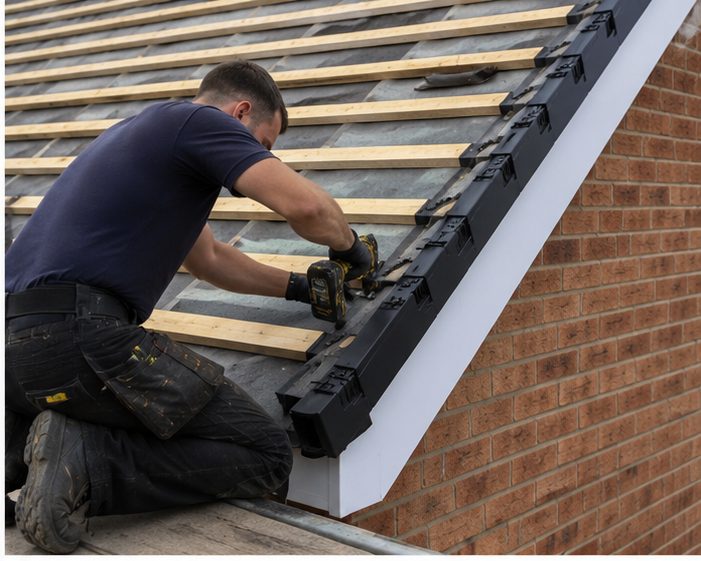
How a dry verge works
A dry verge uses mechanically fixed verge units and tile-end or cap pieces, with no wet mortar. Fixed to the roof structure and following the tile maker's guidance, they resist wind at the edge and leave nothing to crack or fall out. They also keep weather, birds and insects out of the gap that failed mortar leaves open.
- Fixed units held to the roof structure
- No mortar to shrink, crack or drop
- Better resistance to wind at the roof edge
- A tidier closed edge against birds and insects
Where mortar still has a place
If the existing mortar is sound and the roof is otherwise in good condition, a minor repair may be enough. Some tiles or roofs also do not suit a dry system. Compatibility depends on the tile profile, so we check on site rather than assuming. Honest advice includes saying that a small repair can be the right answer.
A mixed approach is possible too. We sometimes repair a short length of sound mortar and fit dry verge only where it has failed, and we explain how the two will meet. What matters is that the choice is made on what is in front of us, not on habit or what is quickest to fit.
When a dry verge is the better choice
Where mortar has failed, cracked widely or been repaired several times, a dry verge is usually the better answer. It also suits new roofs and re-roofs. On the exposed sides of Nailsea houses, where wind gets at the edge first, taking the weakest link out is sensible. Old mortar is removed, the edge is checked, and the new units fitted.
What neither will fix
Neither a dry verge nor new mortar cures a roof that is failing elsewhere. Slipped tiles, tired ridge bedding and poor flashings still need their own attention. We look at the whole roof, tell you what we see and help you decide whether the verge is the thing to tackle first or one item in a wider plan.
Frequently Asked Questions
Is a dry verge always better?
Not always. It is usually the stronger answer where mortar has failed or the roof is being re-covered, but a sound mortar verge can sometimes be repaired. We look at the edge and the tiles before recommending.
Will a dry verge look different?
The verge units sit neatly along the edge and give a clean, uniform line. Colour and profile are chosen to suit the tiles, and we show you what will be fitted before work starts.
Can I tell which I have from the ground?
Mortar looks like a cement line along the gable; dry verge looks like fixed cap pieces. If you see cracks, gaps or bits of mortar on the ground, the edge needs a proper look.
Talk to our team about dry verge systems in Nailsea
Every roof is different — the fastest way to get an accurate answer is a quick chat with our team.