
Cracked verge mortar leaves a sheltered gap that birds, bees and wasps are glad to use. A dry verge closes it. Here is what changes at the gable edge of a Nailsea roof.
Birds and insects look for sheltered gaps, and failing mortar at a gable creates plenty. After a few seasons of exposure to westerly weather, verge mortar on Nailsea houses can crumble away, leaving small openings along the edge. A dry verge fills that line with fixed units, so there is less room for anyone to move in.
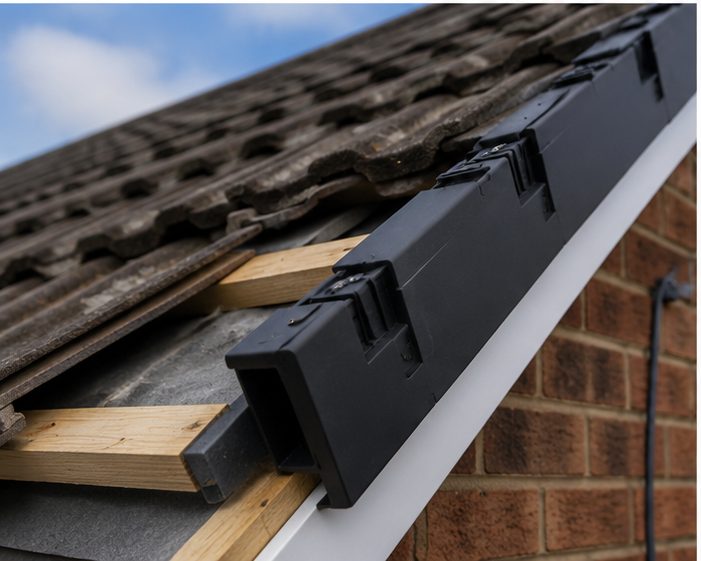
The gaps that old mortar leaves
Mortar shrinks as it ages and the weather cracks it. The result is a thin channel running back under the edge tiles, dry and out of the wind. Starlings and sparrows nest in such spaces, bees and wasps find them too, and the nesting material then holds damp against the tiles and timbers, speeding up the decay.
On an estate roof the same house type often repeats along a road, so what one gable shows tends to be matched by its neighbours; the cause is the age of the mortar and the exposure, not a one-off fault. Seeing it happen early is useful, as clearing a young nest and closing the gap is far easier than repairing a long stretch of damaged edge.
What changes with a dry verge
Dry verge units are mechanically fixed and tile-end or cap pieces fit snugly, so the opening is closed up. With no mortar to fail, the edge stays tight, which makes it far less inviting for nesting and less open to wind-driven rain. It is not a magic barrier, but it removes the easy entry points.
- Edge closed with fixed units, not crumbling mortar
- Fewer sheltered gaps for birds to nest in
- Less room for bees or wasps to settle
- Tidy edge that sheds rain and wind better
If a nest is already there
If birds are nesting, we do not disturb them while the nest is in use, and the work waits until it is clear. For a wasp or bee nest in the edge, a pest controller may need to deal with it before the roofer starts. We can plan around that, and close up the opening once the space is empty.
What we do on the day
Old mortar is removed and the edge is cleaned out, including any nesting material. We check the tile ends and the timber behind them, and fit the units following the tile maker's guidance. Which system suits depends on the tile profile, so we confirm that on site, and the finished edge is neat, firm and closed. Anything we move is bagged and taken away.
What it will not cure
A dry verge keeps the edge closed, but a roof that is open elsewhere, for example at the ridge, eaves or a damaged tile, can still let birds and insects in. We look at the whole roof so the work targets the real gaps, and we tell you what else we find at the same visit.
Eaves, ridge ends and holes where pipes pass through the roof are other places where birds and insects find a way in, and we look at them during the visit so the problem is not simply moved elsewhere. Doing that in one visit saves a second call.
Frequently Asked Questions
Will birds still try to nest at a dry verge?
They may look, but with fixed units and no open gap there is little to use. Nesting is far less likely than with crumbled mortar. The fixed units and cap pieces leave very few gaps along the edge, though no roof edge can be called completely sealed against everything.
Will you remove a bird nest to do the work?
We do not disturb a nest while birds are still using it, so the job waits until the nest is finished with. We plan the visit around that, then clear the space and close the edge once it is empty.
How do I know if my verge has a nest?
Look for twigs, droppings or birds going in and out under the edge tiles, or a buzzing near the gable. Please do not poke at it or climb up; tell us and we will advise.
Talk to our team about dry verge systems in Nailsea
Every roof is different — the fastest way to get an accurate answer is a quick chat with our team.