
A dry verge is a worthwhile upgrade where it suits, and a poor idea where it does not. These are the checks to make before you agree to one on a tiled semi.
The gable edges on Brentry's semis and short terraces take the brunt of weather from the side, and a failing verge is often what first prompts owners to look at dry verge systems. Before you commit, it is worth making sure the system suits your tiles, your edge and your roof.
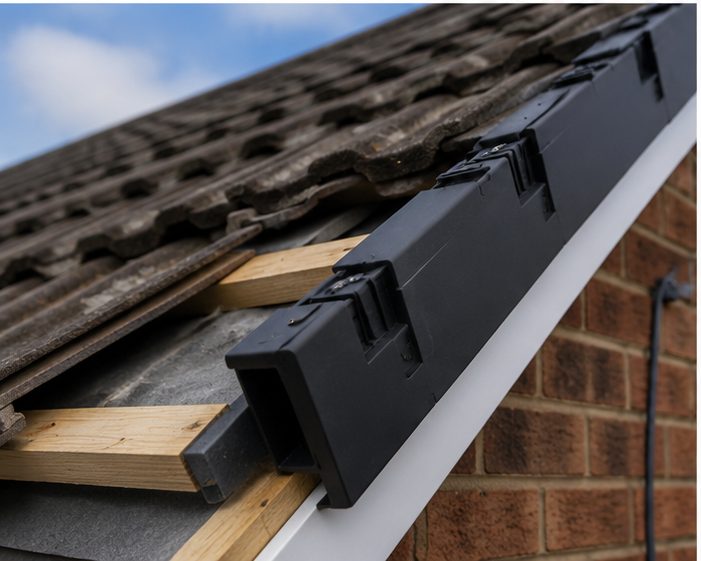
Does it suit your tile?
Dry verge units are made for specific tile shapes, and not every tile has a compatible unit. We identify the tile on site, look at the profile and check that a matching system exists. If the tiles are unusual or worn, we tell you before anything is ordered, rather than discovering a mismatch on the day.
What condition is the edge in?
Cracked mortar, loose edge tiles and stains on the gable wall all show the verge has been letting water in. Check the ground beneath for mortar crumbs. Inside, we look at the rafter or wall plate at the gable for damp. If the timber is wet, it has to be sorted before any new edge is fitted.
A dry verge is not a bandage for damaged structure, and we say so if that is what we find. If the edge timbers are wet or decayed, those are repaired first, and the new verge goes on afterwards to a sound base.
- Mortar debris on paths or drives
- Edge tiles that wobble or sit uneven
- Damp marks on the gable wall inside
- Gaps between tiles and the wall
What about the rest of the roof?
A dry verge is not a cure for a roof failing elsewhere. If the tiles are breaking up or the felt is perished, new edge units will not solve it. We look at the whole slope and tell you honestly whether a stand-alone verge job is sensible or whether a larger repair is on the cards.
How it will be fixed
The units should be fixed mechanically, following the tile maker's guidance, with the correct fixings and end pieces. Ask how many fixings are used, how the old mortar will be removed and how the finished edge will look. Some roof work may need planning or Building Regulations checks, and we advise before work starts.
Questions to put to the installer
Ask for the product and tile match in writing, along with a description of the work. Ask what access is being used and how the site will be left. Vague talk of a universal product is a warning sign. A clear, specific answer to each question suggests the job has been properly considered.
A site visit, a measured description and the maker's fixing guidance should all be on offer. If a quote comes without anyone looking at the gable, treat it with caution, since the tile match and edge condition cannot be judged from the road.
Frequently Asked Questions
Can a dry verge go on any gable?
Most gables, provided a compatible system exists for the tile and the edge timbers are sound. We check both on site. A tricky layout can sometimes still be done with careful cutting and the right end pieces.
Will it stop birds and insects getting in?
The closed design is meant to help keep birds, insects and weather out of the roof edge. It works best when the units are properly fitted, so the quality of the fixing matters as much as the product.
Is a dry verge worth it on an old roof?
If the roof is otherwise sound and only the mortar has failed, yes. If the whole roof is tired, it is usually better combined with a re-roof, rather than fitting new edge units onto worn tiles.
Talk to our team about dry verge systems in Brentry
Every roof is different — the fastest way to get an accurate answer is a quick chat with our team.