
A tatty fascia is more than a cosmetic issue. Once the board gives way, water, wind and wildlife all get a way into the roof edge.
Walk around the older streets of Brentry and you will see fascias with peeling paint, gaps and gutters leaning away from the wall. It is easy to put these down to tired decoration. In practice, a damaged fascia often means the edge of the roof is no longer properly closed, with consequences further in.
The board that holds everything up
The fascia carries the gutter, supports the lowest row of tiles and shields the rafter ends. If it is rotten or loose, the gutter tilts the wrong way, the edge tiles can drop and the felt at the eaves lies exposed. Each of those lets rain reach timber that was meant to stay dry.
On semis with a garage or porch beside the main roof, water running off the higher slope often lands on the lower fascia, so those boards tend to wear faster than the ones at the front and rear of the house.
Rot that spreads inwards
Water that gets behind a bad board soaks the rafter ends and the eaves timbers. Wet timber softens and can pass damp on to the wall plate and the ceiling edge. Because it happens out of sight, the first sign indoors may be a faint stain or flaking paint at the top of a wall.
Wasps, birds and other creatures also take advantage of any gap between board and soffit, which is a nuisance we see often. Once they are in the eaves they can block vents and disturb insulation, so closing the gap properly has more than one benefit.
- Gaps between the board and the wall
- Soffit panels sagging or missing
- Gutters overflowing at the joints
- Stains and flaking paint at ceiling edges
Ventilation and condensation
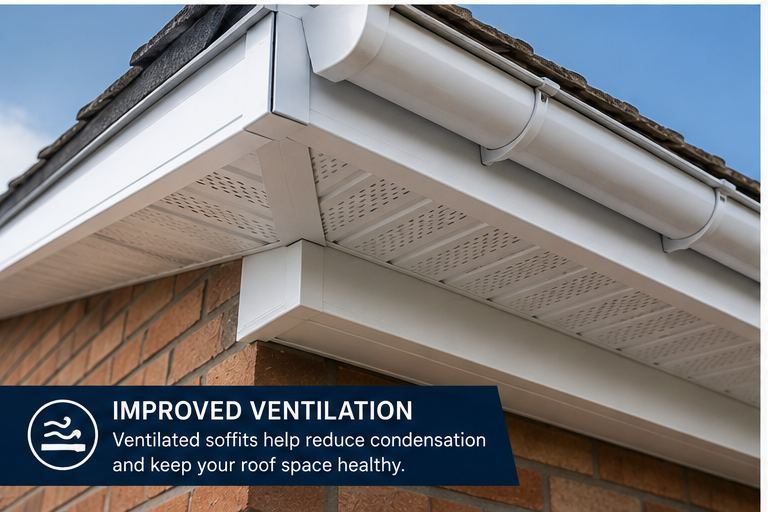
Many soffits carry vents that let air into the roof space. Damaged soffits, or old ones blocked up by paint or debris, can leave the loft stuffy. Condensation then forms on timber and insulation, which can look like a leak. When we replace boards we make sure the roof can breathe properly.
What we check and do
From the ground we look at the whole roofline, then closely at the rafter ends and eaves once access is set up. If timber is sound, we fit new boards and soffits, vented as needed, and refit gutters. If rafter ends are damaged, we deal with them first. Where homes are older, we check what the existing soffit is made of before disturbing it.
When to act
Do not wait for a stain indoors. Peeling paint, sagging gutters and open gaps are all reasons to ask for a check, which we do from safe access. A prompt look can keep the work to boards and gutters. If any work may need planning or Building Regulations checks, we advise before work starts.
Frequently Asked Questions
Can a bad fascia let rain into the loft?
Yes. A gap behind the board or a dropped edge tile lets rain reach the felt and rafters. It may take a while to show indoors, but the damage builds up unseen at the eaves, and by the time a stain appears it is usually well established.
Should I paint over a peeling fascia?
Painting over damp or rotten timber just traps moisture. If the board is sound, a proper preparation may be enough. If it is soft, it needs replacing, and UPVC is an option that needs only cleaning afterwards.
Do garage and porch fascias matter as much?
Yes. They carry gutters and protect the edges of those roofs in the same way, and they are often the first to fail because water from the main roof runs across them and sits on the lower board for longer than you might expect.
Talk to our team about UPVC fascias and soffits in Brentry
Every roof is different — the fastest way to get an accurate answer is a quick chat with our team.