
Blisters, cracks and splits are signs the covering is under strain. Trapped moisture, movement and age usually work together, and the surface tells us where to look next.
Flat roofs in Clifton often sit behind parapets or on rear extensions, bay tops and dormers added to Georgian and Victorian terraces. Those small roofs work hard, and their coverings show it. Blisters, cracks and splits are symptoms of specific things going wrong, and understanding them helps decide between repair and replacement.
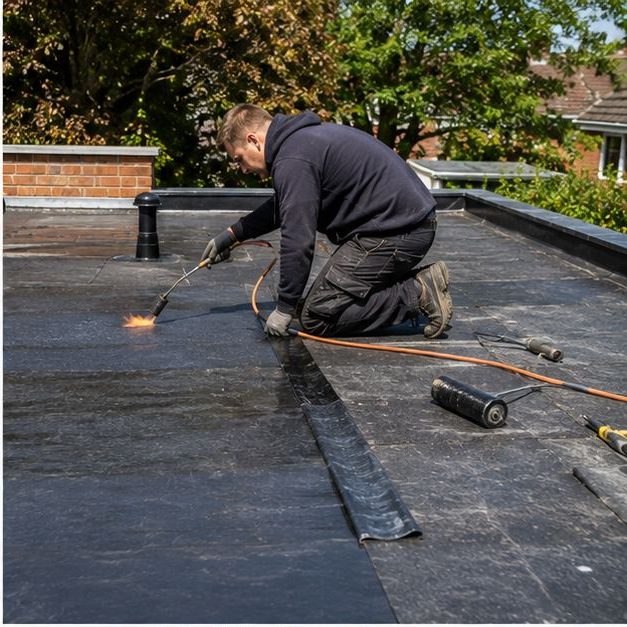
Why blisters form
A blister is a pocket where the covering has lifted away from what is beneath. Moisture or air trapped under the surface expands when the sun warms it, and pushes the layer upward. Small blisters may be harmless for a time, but they weaken the covering, and a blister that splits lets water straight in.
Older roofs on terraces were often repaired in layers over the years, and each layer can trap moisture from the one before. Peeling back a blister sometimes shows damp insulation or a deck that never fully dried, which is why we look beneath, not only at the surface.
Cracks and surface crazing
Cracking is usually the surface giving up. Sunshine, cold and years of weathering dry out the top layer until it can no longer stretch. On roofs behind parapets, where there is little airflow, the surface can stay damp and age faster. Cracks are often worst along folds, edges and anywhere the covering was bent.
- Sun and cold drying out the surface
- Folds and corners where the covering is stretched
- Surface damage from foot traffic
- Debris trapped on the roof wearing the covering
Splits and movement
A split is a clean break, and it usually points to movement. Old timber decks shrink, joints open and the building moves slightly with the seasons. The covering, bonded to the deck, is pulled until it tears. Splits often run along deck joints or at the junction with a wall, and they rarely stop growing.
Tall parapets and neighbouring walls also change how a flat roof behaves. Shade keeps some areas damp for longer while other areas bake in the sun, so the covering ages unevenly, and the cracks and splits we find tend to follow those patterns.
Edges, joints and upstands
Many failures begin at the details. Where the covering turns up a wall, runs under a parapet coping or finishes at an edge trim, it is under extra strain and exposed to water. If the sealing or flashing has lifted there, water gets in behind the covering and can cause blistering and rot in the deck beneath.
- Upstands where the covering has pulled away
- Edge trims that have loosened or corroded
- Joints and laps that have opened
- Penetrations such as pipes and rooflights
Repair or replace
We look at how widespread the damage is and what lies under the surface. A few isolated splits on a sound deck can be repaired. Widespread blisters, wet insulation or a soft deck mean patching would only delay matters, so we say so and describe replacement systems in general terms, in writing, before any work starts.
Frequently Asked Questions
Is a small blister a problem?
Not always straight away, but it is worth watching. If it grows, splits or sits near a joint, water can get in. We can assess it and tell you whether a small repair now avoids a larger job later.
Can I seal a crack myself?
We would rather you did not. Roof access is risky, and sealing over a crack can trap moisture and hide the real cause. Tell us what you see from the window and we will check it properly.
Does one split mean the whole roof is failing?
Not necessarily. A single split on a sound deck is often repairable. If you find several, or the surface is crazed and brittle everywhere, that suggests the covering is tired, and we explain the options honestly.
Talk to our team about flat roofing in Clifton
Every roof is different — the fastest way to get an accurate answer is a quick chat with our team.