
Fitting new boards over old timber looks quick, but it can hide rot and trap damp. Whether it is ever sensible depends on what lies beneath, which we check before deciding.
The idea of clipping UPVC over existing boards is appealing, since it avoids stripping everything off. On a Georgian or Victorian house in Clifton, where eaves details can be complex and the timber may be old, it needs a cautious answer. In most cases, removing the old boards is the more reliable route.
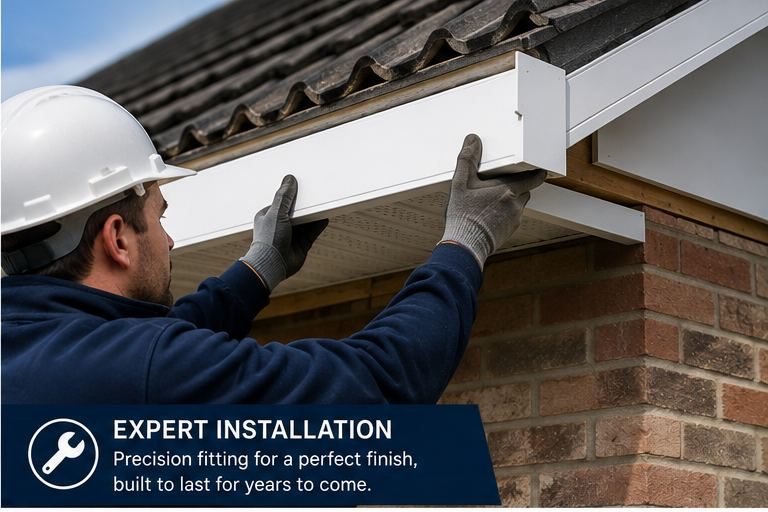
What capping over means
Fitting over existing timber means leaving the old fascia in place and covering it with new boards. It is quicker in the short term, and in the right circumstances it can work. The old board has to be fully sound, firmly fixed and flat. Otherwise the new boards inherit every weakness underneath.
A decision to cover over should always follow a close look at the eaves, not the paintwork. Boards that look reasonable from the pavement can be soft where the gutter brackets are fixed, or where two lengths meet, and those are the places where we begin.
The trouble with covering rot
Timber that is wet or rotting goes on rotting under a cover. You cannot see it, and the new board hides the evidence. Fascias hold the ends of the rafters together and carry the gutter, so hidden decay can spread. A good-looking new face over soft wood is a false economy.
- Soft or crumbling timber behind the cover
- Gutters hung from boards that cannot hold them
- Gaps where birds or insects can get in
- Damp trapped between old and new boards
When it can be considered
There are limited cases where capping may be reasonable: the timber is sound, flat and dry, fixings are secure, and the roof edge is in good order. Even then, ventilation to the roof space needs thought. We examine the boards, rafter ends and soffits first, and tell you honestly whether capping is worth considering.
Another issue is that the extra thickness changes how the soffit meets the fascia, which can leave gaps or reduce the space for ventilation. Where several layers are involved, the result can look heavy beside the neighbouring houses on the terrace.
What replacement gives you
Taking the old boards and gutters off lets us see the rafter ends, wall plate and eaves felt, and put right anything that has been hiding. New boards go on level and firmly fixed, with vented soffits or vent strips for a breathing roof space. Gutters are refitted or replaced. Scaffold or safe access is arranged for this.
- Rafter ends checked and treated if needed
- New fascias fixed square to sound timber
- Vented soffits or ventilation strips fitted
- Gutters set to fall properly to the downpipes
Older houses and what we check first
On older houses we check what existing soffit boards are made of before disturbing them, and we plan the removal carefully. Some work may need planning or Building Regulations checks — we advise before work starts. UPVC is cleaned, not painted, and comes in white and darker or wood-effect finishes, so you can choose something that suits the building.
Frequently Asked Questions
Is capping less work than replacing?
Capping can save effort at the start, but if the timber under it is poor you end up paying twice. We would rather you saw an honest assessment of the boards first, so you can decide with the full picture.
Can you tell if the old timber is sound from the ground?
Not always. Peeling paint and stained boards are warning signs, but soundness is judged by looking closely from safe access and probing the timber. We do that as part of an inspection before advising.
Will new boards affect the roof space ventilation?
They can, in a good way, if vented soffits or vent strips are included. Eaves ventilation helps the loft stay dry. We check the existing airflow and fit vents wherever the roof needs them.
Talk to our team about UPVC fascias and soffits in Clifton
Every roof is different — the fastest way to get an accurate answer is a quick chat with our team.