
Wind attacks a roof at its edges first. A dry verge fixes the gable edge mechanically rather than relying on mortar, which helps, though it cannot rescue a roof failing elsewhere.
On Clifton's steep, exposed roofs the gable edge is where wind gets its grip. Air is forced up and over the verge, pulling at tiles and the mortar that holds them. A dry verge changes how that edge is held, and that matters in a gale, but it is one part of a roof, not a cure-all.
Why the verge is vulnerable
At a gable the roof simply stops. Wind hits the wall, rises over the edge and creates suction on the outermost tiles. On steep slopes the effect is stronger. Traditional mortar bedding is asked to resist that suction through its bond alone, and as it cracks and weathers the edge tiles lose their anchor.
How a dry verge is held
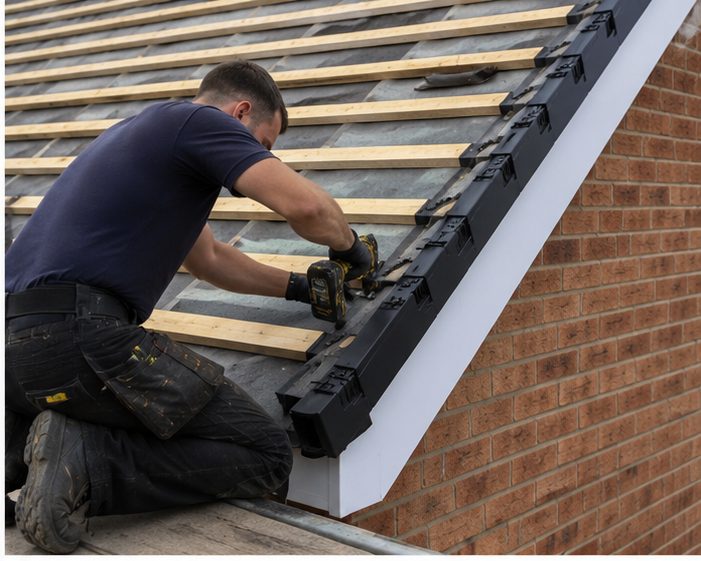
A dry verge uses mechanically fixed verge units and tile-end or cap pieces, secured to the roof structure. There is no wet mortar to crack or wash out. The fixing does the holding, which is why the edge copes better with gusts. Fixing follows the tile maker's guidance, and compatibility depends on the tile profile, so we check on site.
On a steep roof the edge tiles have a long lever arm for wind to work on, so any weakness in how they are held shows quickly. A mechanical fixing along the verge removes much of that weakness, which is the main reason we suggest it for exposed gables.
- Units screwed or clipped to the roof structure
- Tile-end pieces locked in line along the edge
- No mortar to shrink, crack or drop out
- Weather, birds and insects kept out of the edge
What this does for wind resistance
The gain is a firmer edge. The outer tiles are held down by fixings rather than by a bond that weakens over time, and the covering stays tidy and closed. A dry verge will not make a roof storm-proof, but it removes one weak link that wind commonly exploits, and it avoids the cycle of repeated mortar repairs.
What it cannot fix
A dry verge is not a cure for a roof failing elsewhere. If tiles are slipping across the slope, battens are soft or the ridge is loose, the edge alone will not save the covering. We look at the whole roof and tell you honestly whether the verge is the real weak point or whether broader work is needed.
- Slipping tiles in the middle of the slope
- Soft battens or tired felt
- Loose ridge or hip bedding
- Failing lead flashings and valleys
Where it suits best
Dry verge suits new roofs, re-roofs and repairs where mortar has already failed. On older terraces, we talk through how it looks beside neighbouring roofs and whether the tile profile allows it. Some work may need planning or Building Regulations checks — we advise before work starts. We describe the system and fixings in writing before the job begins.
Fixing details and the finished look are agreed with you before work starts, including how the new edge sits beside the neighbouring roofs on the terrace. We also explain what the fixings are, how many hold each unit and what happens at the ridge end, so nothing about the edge is left vague when the work is finished.
Frequently Asked Questions
Will a dry verge stop tiles blowing off in a storm?
It helps the edge, which is where wind is most damaging, but it cannot promise the roof will survive every gale. The rest of the roof also needs to be sound and well fixed. We assess the whole slope before recommending it.
Does a dry verge suit every tile?
No. Units are made for particular tile profiles and the system has to be fixed to the tile maker's guidance. We check your tiles and the roof structure on site before saying whether a dry verge is the right choice.
Is the verge the first place wind damage starts?
Often, along with ridges and hips. Edge tiles take the strongest suction, so loose mortar or lifted tiles there are common storm findings. Falling mortar on paths and drives is a typical early sign.
Talk to our team about dry verge systems in Clifton
Every roof is different — the fastest way to get an accurate answer is a quick chat with our team.