
Replacing a garage flat roof follows a clear order, from stripping and deck repairs through to edges and the new surface. Knowing it helps you ask the right questions up front.
Garages in Hanham, whether beside older village homes or part of the inter-war and post-war estates, often have a flat roof that has aged badly. A replacement is a contained job that should be planned in steps. Here is how we go about it and what you should expect to be told.
Judging if it needs replacing
First we look at whether the roof is beyond repair. Ponding, widespread cracks, blisters, lifting edges and damp patches on the ceiling inside the garage all count. A localised fault can be patched. Where the covering has failed over most of the roof, a new one is the sensible choice. We explain which applies and show you the evidence. Photos from inside the garage help us plan before the visit.
Stripping back and finding the truth
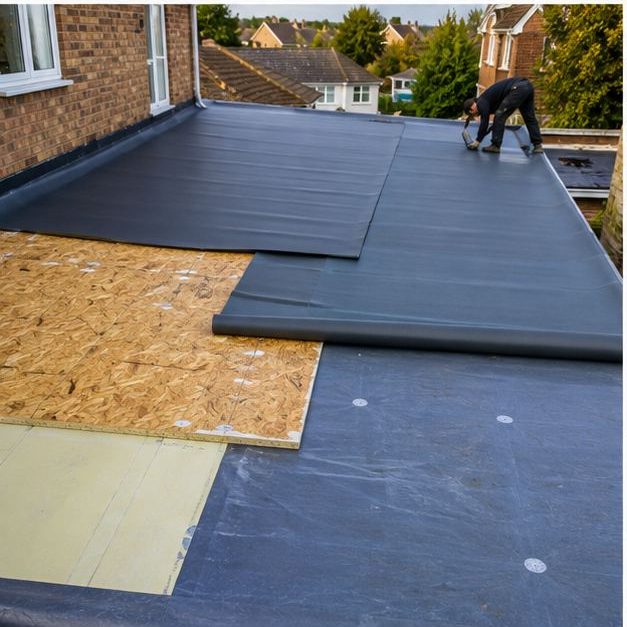
The old covering is removed down to the deck. Only then do we see the true state of the boards. Wet or rotten boards are cut out and replaced, and the joists are checked. It is far better to find this at the start than to cover a rotten deck. Any rainwater outlet is checked and, if needed, replaced.
- Rotten or soft boards cut out and renewed.
- Joists and bearings inspected for soundness.
- Outlets and gutter fixings checked.
- Old covering taken away from site.
Falls, insulation and trims
A garage roof needs a fall so water leaves. If the deck is flat or dished we correct it with firrings or new boards. If the garage is used as a workshop or has living space, insulation is worth adding. New edge trims are fitted so water drips clear of the wall and into the gutter. The detail at the wall junction is formed with a proper upstand.
Choosing a covering
Typical choices are single-ply rubber, fibreglass or a felt system. Rubber suits simple shapes with fewer details, fibreglass handles awkward corners well, and felt systems have a place on some roofs. We talk through the pros and cons for your garage and recommend the one that suits, rather than the one that is simplest for us.
- Rubber for simple shapes with few details.
- Fibreglass for awkward corners and edges.
- Felt systems where they suit the roof.
- A sound edge detail whichever covering you choose.
Finishing and handover
When the covering is down we check the joints, corners and outlet, and clear the site. Planning or Building Regulations checks may be needed in some cases and we advise before work starts. Before you agree, ask for a written description that covers deck repairs, the covering type and what happens if rot is found. On sloping plots, we also look at where the water discharges so it clears the garage wall and neighbouring boundaries.
Frequently Asked Questions
How disruptive is the work?
Not very. Most of the work is overhead, so you can usually carry on using the house. We ask you to clear the drive for access and move anything fragile away from the garage walls, and we tell you the plan beforehand.
What if the deck is rotten?
We cut out the bad boards and replace them before laying anything new. It is the right way to do it. We tell you what we find, show you photos and explain what it means for the job.
Should I choose rubber or fibreglass?
It depends on the shape of the roof, its details and how you use the garage. Rubber suits simple shapes; fibreglass copes with awkward edges. We look at your roof and recommend one with our reasons.
Talk to our team about flat roofing in Hanham
Every roof is different — the fastest way to get an accurate answer is a quick chat with our team.