
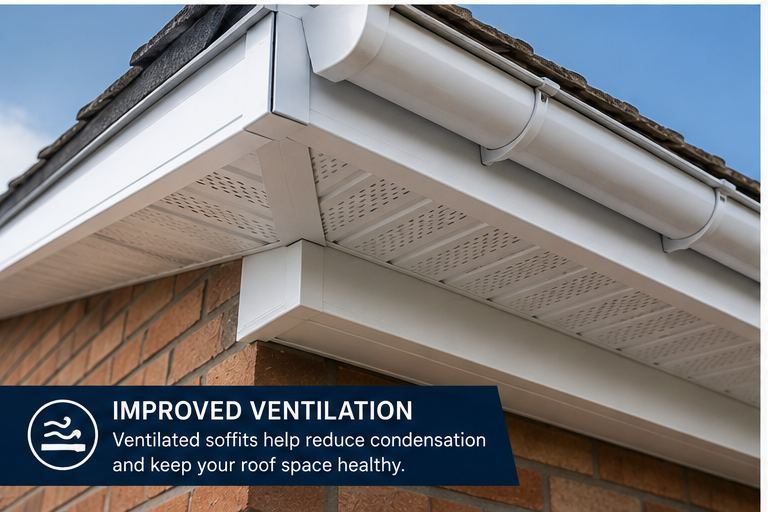
Vents in the soffit let air in at the eaves, so damp air can leave through the roof. Without them, a loft can turn damp, whether the house is old or newer.
The soffit is the board under the eaves, and in modern replacement work it is where fresh air enters the roof. Hanham has older homes and plenty of inter-war and post-war houses, and all of them have lofts that need to breathe. Here is why vents matter and what we fit.
The loft needs to breathe
A roof space with no airflow fills with damp air from the house below. Cooking, washing and ordinary living all add moisture, and some of it rises. When that air meets cold timber or felt, it turns to water. Over time that wets insulation, spots rafters with mould and can be mistaken for a leak. Air moving through the loft carries moisture away. A musty smell at the hatch is often the first clue.
How the air gets in and out
Fresh air comes in at the soffit, travels up under the covering and leaves at the ridge or other vents. A vented soffit has small openings or a strip along its length. These allow a steady trickle without letting in rain, birds or insects. Without them the air path is closed, however good the roof covering above may be.
- Intake at the eaves through the soffit.
- Air moves up along the roof slope.
- Moist air leaves at the ridge or high vents.
- Mesh keeps out insects and birds.
Insulation can block the path
Loft insulation is good for heating bills, but if it is pushed hard against the eaves it can choke the gap that the air needs. Over the years, in a house that has been insulated and re-insulated, this is common. When we replace soffits we check the eaves and make sure the airflow is not blocked by insulation.
- Insulation stuffed tight into the eaves.
- Old boards painted over with no openings.
- Birds nests or debris blocking the gap.
- Felt dipping and covering the intake.
What changes when boards are replaced
Replacement is the best moment to put ventilation right. We take off the old fascias, soffits and gutters, check rafter ends, then fit new boards with vented soffits or vent strips. Gutters are refitted or renewed. Scaffold is needed for access. On older homes, we check what existing soffit boards are made of before disturbing them, and tell you if anything needs special handling.
Signs of poor ventilation
From the hatch you may notice water droplets on the underside of the covering, damp insulation, black spotting on timber or a stale smell. None of these needs you to go on the roof. They are good reasons to have the eaves looked at. We check the soffits, the loft and the roof together, and advise what, if anything, needs doing. Photos taken from the hatch are useful to us.
Frequently Asked Questions
Are vents the same as holes in the soffit?
They are carefully made openings or strips designed to let air through while keeping pests out. A random hole does not do the job. A purpose-made vent has a mesh or narrow slots and is fitted evenly along the board.
Can birds get in through the vents?
Not through properly fitted ones. The openings are small and protected by mesh or slots. Birds and insects tend to enter where boards are damaged or missing, which is another reason to replace broken soffits.
Do all roofs need soffit vents?
Most pitched roofs benefit from some airflow, but how it is provided varies with the roof design. We look at yours and advise what suits, rather than applying one rule to every house. We check the roof space itself rather than guess.
Talk to our team about UPVC fascias and soffits in Hanham
Every roof is different — the fastest way to get an accurate answer is a quick chat with our team.