
Mortar can last when it is well made, but it is the part of a verge most likely to crack and fall. A dry verge takes mortar out of the equation. Here is how to choose.
The verge is the roof edge at a gable, and for years it was finished in mortar. Hanham has older homes with traditional verges as well as inter-war and post-war roofs, and many of them show cracked or crumbling mortar. Whether to repair it or switch to a dry verge depends on a few things.
How mortar behaves
Mortar is a traditional finish and can look neat. But it sits exposed to rain, frost and wind, and over time it shrinks, cracks and breaks away. Pieces fall onto paths and drives, which is often the first thing people notice. The gaps then let in weather and give birds and insects a place to nest. Repointing helps for a while, but it is the same material doing the same job.
How a dry verge differs
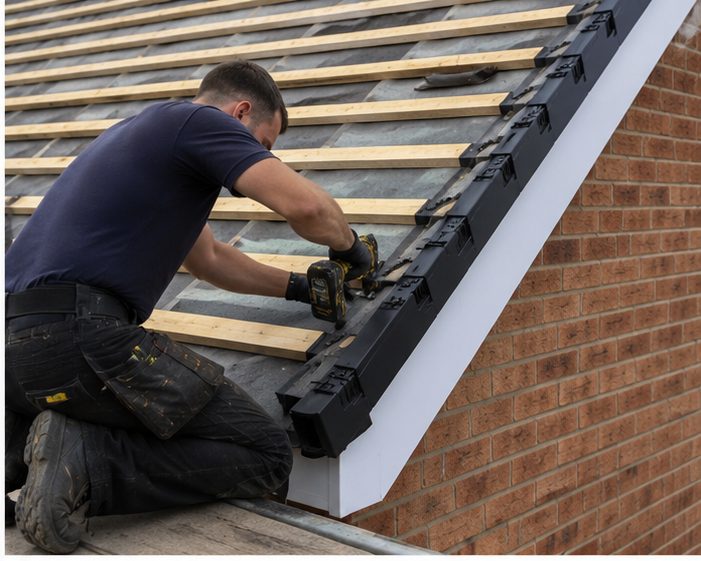
A dry verge uses mechanically fixed units with tile-end and cap pieces and no wet mortar. The edge is held by fixings, not by a bed that can wash out. That gives better resistance to wind at the edge, no mortar to fail and a closed edge that keeps weather, birds and insects out. We fit it to the tile maker's guidance.
- Fixed units in place of a mortar bed.
- Better grip on tiles at the exposed edge.
- No cracked mortar falling to the ground.
- Edge closed against birds and insects.
When mortar still makes sense
There are cases where keeping mortar is fine. A verge that is sound, well bedded and on a roof in good order may not need changing. Some tile profiles are not suited to a dry system, and some traditional roofs are best kept in character. We check the tile, the condition of the edge and what you want, and say honestly when mortar repair is enough.
- The existing mortar is sound and well bonded.
- The tile profile does not suit dry units.
- The roof is traditional and meant to stay that way.
- The edge is not exposed to strong wind.
What a dry verge will not fix
It does not repair a roof that is failing elsewhere. If the battens, felt or tiles are worn out, a dry verge will not change that. It also depends on tile compatibility, which we check on site. It is best fitted on new roofs, re-roofs and repairs where mortar has failed, rather than as a cosmetic add-on.
How we help you decide
We look at the verge from the ground and the roof, check the tiles and battens along the edge, and tell you whether to repair, re-bed or fit a dry system. We explain what each option involves and what to expect afterwards. On the open edges towards the river in Hanham, wind resistance is worth thinking about.
Frequently Asked Questions
Is dry verge always better than mortar?
Not always. It is usually the more durable and wind-resistant choice, but it depends on the tile and the condition of the roof. We check on site and recommend what suits your house.
Can a dry verge go on an old roof?
Often yes, where the tiles are compatible and the battens at the edge are sound. We check both before suggesting it. If the roof is worn out, the whole covering may need attention first.
Will the roof look different?
A little. Dry verge units have a clean, defined edge and are available in colours to match the tiles. Some people prefer the traditional mortar look, and we discuss that with you honestly.
Talk to our team about dry verge systems in Hanham
Every roof is different — the fastest way to get an accurate answer is a quick chat with our team.