
Repair suits a roof that is sound apart from a few faults. Replacement suits a roof that is failing across its surface. The evidence, not the age, decides which applies.
Many roofs in Redfield have been patched for decades. At some point the question arises whether another repair is sensible or whether the whole slope should be redone. A fair answer starts with looking at the whole roof, not just the spot that is leaking. We look at evidence first.
What repair is good for
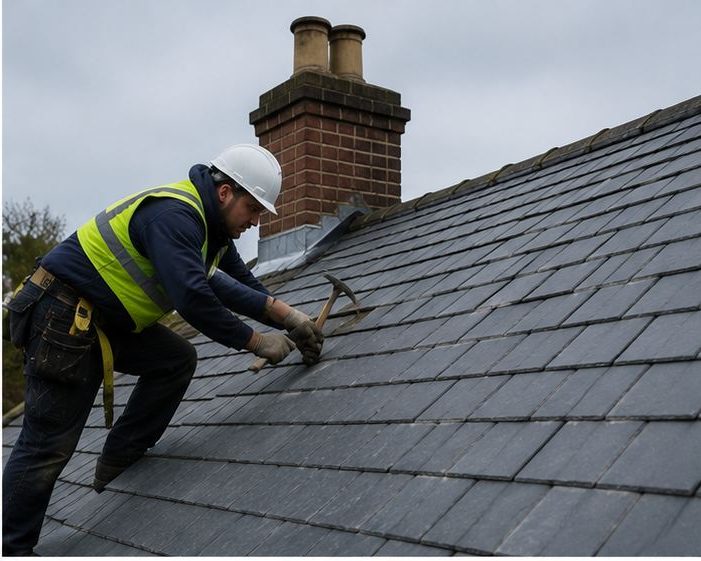
Repair makes sense when the problem is local and the rest of the covering is firm. A few slipped tiles, a failed flashing, a cracked ridge or a blocked valley can be put right without disturbing the rest. If the felt and battens beneath are sound, a tidy repair can serve the roof for a good while.
A repair is also quicker and less disruptive on a terrace where access is tight, which is a point in its favour when the roof is otherwise healthy. It means less scaffold, less noise and fewer days of upheaval for you and the neighbours.
Signs that replacement is nearer
Replacement comes into view when faults are spread across the roof rather than clustered in one place. If you see repeated leaks, many cracked or flaking tiles, or a covering that is sagging, it may be time to look at stripping and recovering the roof.
- Leaks appearing in several parts of the roof
- Many tiles or slates cracked, flaking or slipping
- Perished felt and rotten battens seen in the loft
- Repairs failing again soon after being done
What the loft tells us
The underside of the roof often gives the clearest answer. We look for daylight through the covering, dark and damp timbers, stained felt and sagging rafters. Sound timbers and dry felt suggest the roof can be repaired. Widespread rot or perished felt points to replacement, whatever the surface looks like from the street.
Access, scaffold and the practical side
On a Victorian terrace with small yards and limited rear access, replacement needs scaffold, protection for neighbours and careful handling of materials. That is a bigger operation than a repair, so the decision should be based on evidence. We explain what each option involves and what the likely trade-offs are.
Sometimes a staged approach works well, repairing one slope now and planning the other, or dealing with the worst section first so the rest can wait. We explain which staging makes sense and what each step would leave you with.
How to get an honest judgement
Ask for a written description of what was found, with photographs, and for the reasons behind the recommendation. A trustworthy roofer explains what is urgent, what can wait and what happens if you do nothing. Ask for both options to be described. Re-roofing may need planning or Building Regulations checks, and we advise before work starts.
Frequently Asked Questions
Does an old roof always need replacing?
No. Age alone is not a reason. A roof can serve well for a long time if the covering, felt and timbers are sound and faults are dealt with promptly. We judge it on what we can see, not on how old it is.
Is repair just delaying the inevitable?
Sometimes it buys valuable time, and sometimes it is wasted effort. If the roof is failing everywhere, patching will be short-lived. If the faults are local, a repair is a sensible, honest answer and we say so.
Can I replace one slope and repair the other?
Often yes, where one side has taken the weather and the other is sound. We check both and explain whether a staged approach makes sense, or whether doing everything together is simpler and tidier.
Talk to our team about general roofing services in Redfield
Every roof is different — the fastest way to get an accurate answer is a quick chat with our team.