
Wind, age and neglected edges account for most of the roof trouble we see in this part of Bristol. Here are the usual faults, how to spot them and what we do.
Shirehampton has inter-war and post-war houses that have taken many winters of westerly weather. Most roof problems here are not exotic. They are slipped tiles, tired flashings, failing mortar and gutter faults, plus a few flat roof troubles. Knowing what they look like helps you spot them early from the ground.
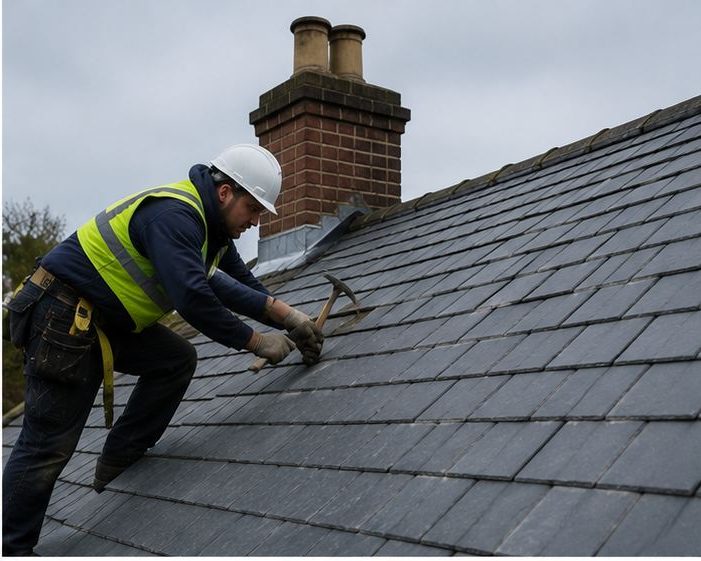
Slipped and cracked tiles
Wind loosens tiles, and old fixings give up. A slipped tile leaves a gap, and a cracked one lets water through. From the ground you might see tiles out of line, pieces on the path or a darker patch on the slope. Fixing a few tiles promptly is much easier than repairing the felt and timbers behind them.
Tiles on the windward slope tend to go first, so it is worth glancing at the west-facing side after a blustery spell. We refix, replace and check the felt and battens beneath before closing the area up, so the repair is not just cosmetic.
Ridge, hip and verge damage
Mortar along the ridge, hips and gable edges cracks as the weather works on it, and pieces fall. Crumbs on a drive or path are a typical first sign. We re-bed ridge and hip tiles, and where a gable edge keeps failing, a dry verge removes the mortar problem altogether.
- Mortar crumbs on paths or drives
- Ridge tiles that look uneven or loose
- Gaps along the gable edge
- Birds or wasps entering at the roof edge
Flashings and chimneys
Lead flashing seals the joins where the roof meets a chimney or wall. It can lift, split or pull away, and the leak that follows often shows far from the cause. A stain near a chimney breast is a classic sign. We check, repair or replace the flashing and look at the pointing around it.
Gutters, fascias and soffits
Blocked or sagging gutters spill water onto fascia boards and walls. Timber boards rot where water sits. When boards fail, the eaves lose protection, and birds and insects can get in. We repair what is sound and replace what is not, including vented soffits so the roof space can breathe.
Vented soffits matter because a roof space that cannot breathe holds damp, and that shows up as condensation on timbers and insulation. Fitting them when boards are replaced is one of the simplest ways to help an older loft dry out and stay healthy.
Flat roofs and extensions
Flat tops on extensions, garages and porches suffer from ponding, cracked joints and blocked outlets. Standing water is a warning, as covering that stays wet wears faster. We repair where the deck and covering are sound enough and replace where the damage is widespread, explaining which applies and why.
Frequently Asked Questions
What is the most common cause of a roof leak?
Often a slipped or cracked tile, a worn flashing or a gutter fault at the edge. Water can travel along timbers before it shows, so the stain is seldom directly below the source.
Are roof problems more common near the river?
Exposure to westerly wind is what shows up most. Edges, ridges and fixings take the brunt, so those are the first places we look when an exposed house has trouble, along with the gutters and fascias at the eaves.
Which problems can wait and which cannot?
Active leaks, loose tiles and failing flashings should be dealt with promptly. Cosmetic wear, moss and minor staining can often wait. We tell you which is which after a full look at the roof.
Talk to our team about general roofing services in Shirehampton
Every roof is different — the fastest way to get an accurate answer is a quick chat with our team.