
Rot in a timber fascia almost always starts with water that cannot get away. We look at the usual causes, how to spot them from the ground, and what replacement involves.
Timber fascias on the inter-war and post-war houses around Shirehampton have been taking weather from the west for a long time. Wood is not the problem on its own. Rot needs wetness that lingers, and the roof edge has plenty of ways to hold water. Understanding where it comes from helps you decide what to do next.
Water that sits
Rot takes hold where timber stays damp, and the bottom edge of a fascia is a natural place for that. Rain runs down the roof, meets the board and sits along the joints and underside. Once the protective paint film cracks, the board soaks up moisture, and the surface then holds water for longer each time it rains.
Boards on houses close to the Avon also meet damp air through much of the year, which slows drying between showers and gives rot more time to take hold along the lower edge and the joints, particularly on sides of the house that rarely see the sun.
Gutters that have failed
A leaking gutter joint, a blocked downpipe or an overflowing run puts water directly onto the board. Gutters also pull loose when they are overloaded with debris, tilting the water towards the wall. Even a small drip repeated through many storms can soften a board in a single spot, so a stain below a joint is a useful warning.
- Dark streaks beneath gutter joints
- Moss or green growth along the board
- Overflow marks on the wall below the eaves
- Gutters pulling away from the board
Paint, wind and exposure
Timber needs repainting regularly to stay protected, and a neglected finish blisters and flakes, letting moisture in. Wind-driven rain from the west pushes water sideways into joints and gaps in places where a sheltered house might stay dry. Boards on the exposed side of the house often show wear sooner than the others.
Hidden damage behind the board
What you see from the ground may understate the problem. Rot can run along the back of a board or into the rafter ends and soffit while the front looks passable. When we replace a fascia, we check the rafter ends and eaves, and on older homes we check what existing soffit boards are made of before disturbing them.
We tell you what we find before work goes further, so that decisions are made on the facts and nothing is replaced that does not need to be. If the rafter ends are sound, we say so and carry on; if not, we explain the options.
Stopping it coming back
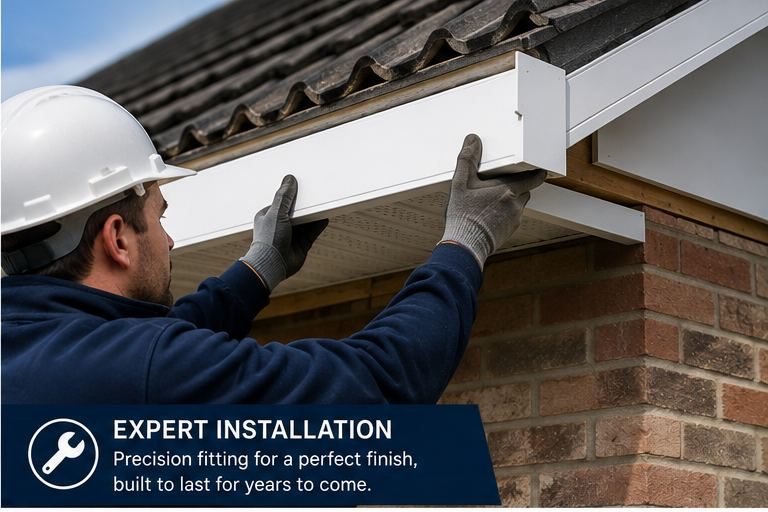
Replacing rotten timber with UPVC removes the need for repainting, as it only needs cleaning and is very low maintenance. The job normally means removing the old boards and gutters, checking the eaves, fitting new boards and vented soffits, and refitting or replacing gutters. Scaffold access is part of the job. A well-fitted gutter system keeps water off the new boards.
Frequently Asked Questions
Can rotten fascia boards be repaired?
Small, isolated soft spots can sometimes be treated, but rot tends to continue under paint. If several sections are soft or the rafter ends are affected, replacing the boards gives a more lasting result than patching.
How can I tell if my fascia is rotting from the ground?
Look for peeling or blistered paint, dark staining, bowing, gaps at joints, and gutters that look loose. If a board looks swollen or has fungus or moss growing on it, it is worth having it looked at.
Will new boards stop rot for good?
UPVC does not rot, so the boards themselves will not. The rafter ends behind them still need to be sound and ventilated, which is why we check the eaves before fitting anything new.
Talk to our team about UPVC fascias and soffits in Shirehampton
Every roof is different — the fastest way to get an accurate answer is a quick chat with our team.