
Lead has been used on Redcliffe's roofs for generations, valued for its flexibility and durability around the complex junctions found on period properties — chimneys, valleys, parapets, and the abutments where terrace roofs meet party walls. That same age, though, means much of it has had decades to weaken, and a serious storm is often what finally exposes a weakness that had otherwise gone unnoticed for years. Even leadwork that has never caused a problem before can reach the end of its useful life fairly abruptly once age and repeated weathering combine in a single severe event.
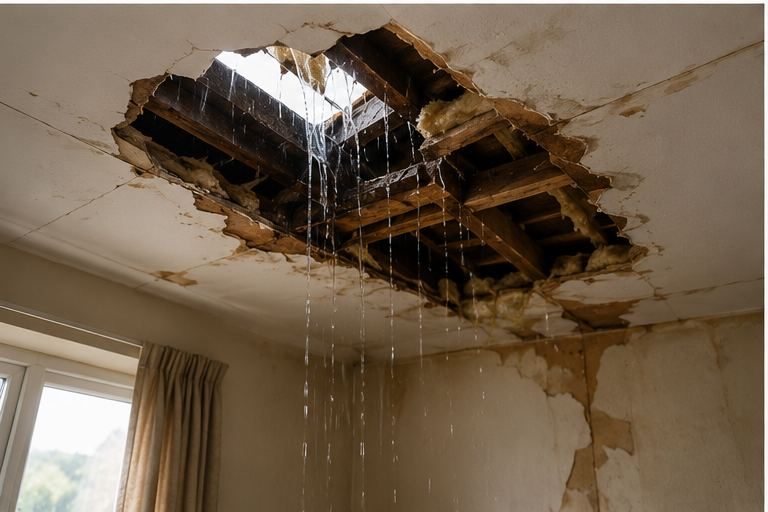
Lead fails in a few characteristic ways during severe weather. Wind can lift edges that have come slightly loose from their fixings, particularly where the mortar or pointing securing them has deteriorated. Repeated flexing in gusty conditions can also fatigue lead that's already thin from age or previous patch repairs, eventually opening small splits that let water through even without any single dramatic failure. On some of Redcliffe's oldest properties, original lead detailing has been repaired more than once over the decades, and each previous patch is another potential point of weakness during a genuinely severe storm.
Because leadwork sits at junctions rather than across open roof slopes, even a small failure here tends to cause disproportionate leaks. A split in valley lead, for instance, can let a significant volume of water through during heavy rain, since valleys are specifically designed to channel water from two roof slopes into one concentrated flow — exactly what you don't want passing through a compromised seal. A parapet abutment or dormer cheek can behave similarly, concentrating water at a single vulnerable point rather than spreading it harmlessly across a wider area of roof.
Terraced properties across Redcliffe add a further complication: leadwork failures near party walls can sometimes affect a neighbouring property as much as your own, since water doesn't respect boundary lines once it's inside a shared roof void or wall cavity. Where this is suspected, it's worth having both properties checked, or at least flagging the issue with neighbours.
Repair generally means removing and replacing the affected section of lead, re-dressing it properly around the relevant junction, and checking that surrounding tiles or slates haven't also been disturbed. Given the age of much of Redcliffe's roofing, a leadwork repair sometimes reveals that other nearby sections are close to needing similar attention, which is useful information even where it isn't urgent. Being told about developing wear elsewhere on the roof, even when it doesn't need immediate action, helps homeowners plan ahead rather than being caught out by the next storm.
Brunel Roofing Bristol carries out emergency leadwork repairs across Redcliffe, with 24-hour call-out, free inspections, and a 15-year guarantee on completed repairs. Our experience with period terraces means we know where to check first for the kind of leadwork wear these properties commonly develop over time.
Need Emergency Roof Repairs in Redcliffe?
Every case is different — the fastest way to get an accurate answer is a quick chat with our team.