
Any point where two roof planes meet, or where a roof meets a wall or chimney, is what roofers refer to as a junction — and junctions are consistently where wind damage does the most harm. On a simple, uninterrupted roof slope, wind has relatively little to work with, but valleys, verges, and abutments create edges, gaps and changes in direction that gusting wind can exploit far more easily. Redcliffe's period terraces, with their varied roof shapes and shared party walls, generally have considerably more of these junctions than a typical modern roof, simply as a consequence of their more elaborate original design and construction.
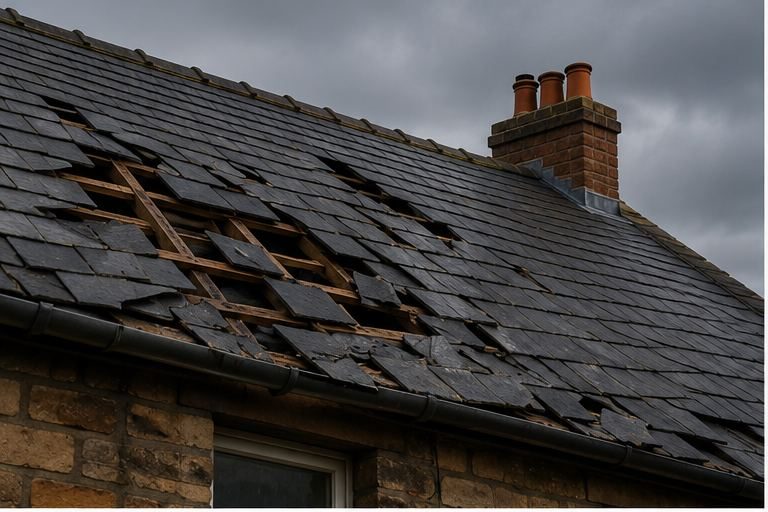
Verges — the edges of a roof where it meets a gable wall — are particularly prone to wind damage because they sit right at the very edge of the tiled or slated covering, with noticeably less overlap and support than tiles in the main body of the roof. Once wind lifts a verge tile or disturbs the pointing that seals it, the exposed edge becomes progressively more vulnerable with each subsequent storm. On end-of-terrace properties across Redcliffe, which have more exposed verge length than mid-terrace homes, this can be a recurring source of minor storm damage over the years.
Valleys, where two roof slopes meet at an angle, concentrate water flow from both sides into a single channel, which means any wind damage here has an outsized effect on the roof's overall ability to shed water properly. A displaced valley tile or a lifted section of valley lead doesn't just create a gap — it creates a gap exactly where water volume is highest during heavy rain.
Abutments, where a roof meets a wall or chimney, rely heavily on flashing to stay watertight, and wind can work at the edges of that flashing over successive storms even without a single dramatic failure. This gradual weakening is part of why junction damage on Redcliffe's older properties sometimes isn't traced to one specific storm, but to cumulative wear that finally gives way during a particularly severe spell of weather.
Because junction damage is often subtle — a slightly lifted tile, a small gap in flashing — it's easy to miss from ground level. A proper post-storm inspection specifically checks these vulnerable points rather than just scanning the general roof surface, which is where damage is most likely to be found. An experienced eye knows exactly where to look first, which tends to make an inspection quicker and more accurate than a general once-over of the whole roof.
If you're concerned about wind damage to roof junctions on your Redcliffe property, Brunel Roofing Bristol offers free inspections and prompt repair, with a 15-year guarantee on completed work. Given how many junctions a typical period terrace roof has, we think a thorough check is always worth the extra few minutes it takes compared with a quick glance from the street below.
Need Emergency Roof Repairs in Redcliffe?
Every case is different — the fastest way to get an accurate answer is a quick chat with our team.