
Heavy rain has a way of finding every weakness a roof has been quietly hiding, which is why leaks so often coincide with the heaviest downpours rather than appearing out of nowhere on an otherwise ordinary day. A gap or crack that's too small to notice during ordinary weather can let a surprising amount of water through once rain is falling hard and fast, and that's exactly the scenario many Shirehampton homeowners find themselves dealing with during a serious storm that catches them off guard. Roofs that have coped with years of ordinary weather without any hint of a problem can still develop a leak the very first time rain falls this intensely, simply because the volume of water involved is so much greater than usual.
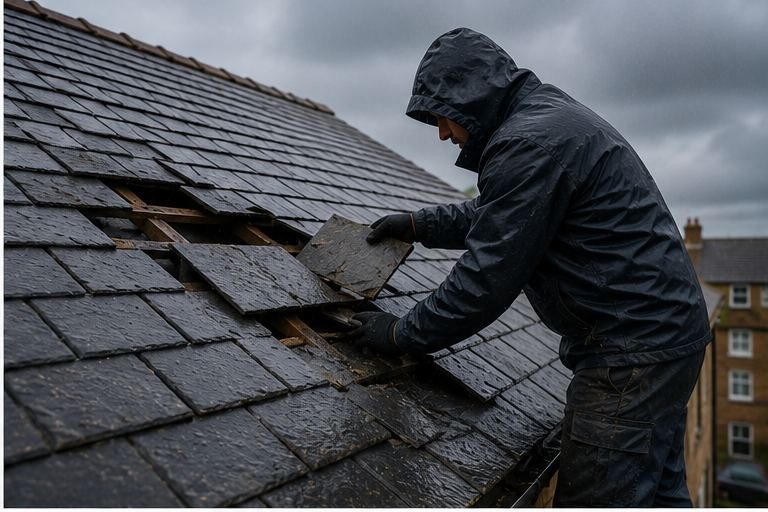
Prolonged or intense rainfall tends to overwhelm points on a roof that were only ever marginally sound, valleys where two roof slopes meet, guttering that's become partially blocked, or flashing that's already slightly lifted from ageing pointing. Water that would normally run off harmlessly instead backs up or finds a way past these weak points, and once it's in, it can travel some distance before showing up as a stain on a ceiling well away from the actual fault causing it. Guttering that copes fine with a light shower can overflow completely once rain intensifies, sending water down the face of the building or back up under the roof edge instead of away from it.
The first priority when a leak appears during or after heavy rain is limiting the damage indoors, catching water with a container if it's actively dripping and moving anything valuable out of the way, while arranging for the source to be properly identified and repaired. Trying to fix the visible symptom without finding the actual entry point rarely solves the problem for good, and often means the same leak reappearing during the next significant downpour. It's also worth checking whether more than one area is affected, since heavy rain can expose several marginal weaknesses at once rather than just the single point that happens to be most obvious.
Once the immediate situation is under control, tracing the leak back to its source usually means checking the roof itself alongside the loft space, since the point where water enters is often some distance from where it eventually appears indoors, particularly on older Shirehampton roofs with more complex timber layouts and multiple additions built up over the years by previous owners. In some cases, water travelling along a rafter can drip at a completely different point each time it rains, depending on how saturated the timber has already become.
A lasting repair addresses the actual cause, whether that's a cracked tile, failed flashing, or a blocked or damaged gutter, rather than simply sealing the point where water happens to be visible, and checking nearby areas of the roof for related weaknesses helps prevent a repeat leak during the next heavy downpour that comes through the area. Addressing the wider roof at the same time, rather than treating each leak as an isolated event, tends to work out more cost-effective in the long run.
If heavy rain has caused a leak in your Shirehampton home, Brunel Roofing Bristol provides a 24-hour emergency call-out to trace and stop the problem, followed by a proper repair with a free quote provided beforehand so you know exactly what to expect and what it will cost.
Need Emergency Roof Repairs in Shirehampton?
Every case is different — the fastest way to get an accurate answer is a quick chat with our team.