
People often use these three words for the same strip along the eaves. They are three separate parts doing three separate jobs, and knowing which is failing saves confusion.
Look up at the edge of a roof and you will see a line of board and plastic that most of us call the guttering. In fact it is made of several parts. On the older terraces and villas of Arnos Vale, where the eaves are often reached by steep ground and awkward access, knowing the difference helps you describe a problem and understand a quote.
The fascia
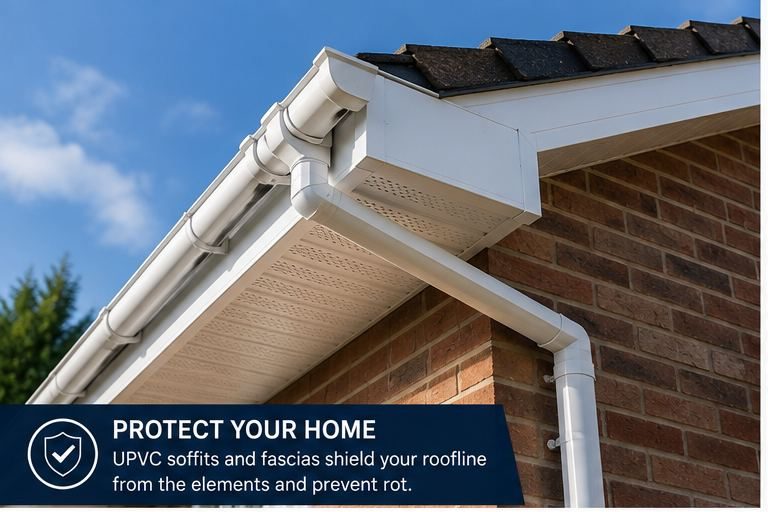
The fascia is the board fixed across the ends of the rafters, the vertical face you see from the street. It carries the gutter and closes off the roof edge. Because the gutter is screwed or clipped to it, any rot or movement in the fascia affects how the gutter hangs. On older houses the fascia is often painted timber; newer or replacement boards are commonly UPVC.
The soffit
The soffit is the board that closes the underside of the eaves, between the back of the wall and the fascia. You see it when you look up from below. It keeps birds, insects and weather out of the roof space, and where it is vented it lets the roof breathe, which helps stop condensation building up in the loft.
The gutter
The gutter is the channel that collects rain from the roof and carries it to the downpipe. It is a separate component fixed to the fascia, and it can fail without the fascia being at fault, or the other way round. Sagging runs, leaking joints and overflow in heavy rain are gutter symptoms, though a rotten fascia behind may be the cause.
- Fascia: vertical board carrying the gutter
- Soffit: underside board closing the eaves
- Gutter: the channel collecting rainwater
- Bargeboard: the board along a gable edge
Which one is giving you trouble
A peeling, soft or dark fascia suggests water has been sitting against timber. A soffit with gaps, holes or sagging sections often means birds or insects have found a way in. A gutter that drips at the joints or overflows in a downpour needs attention to the joints, the fall or a blockage. Often more than one part is affected, so we check them together rather than one at a time.
How we deal with them
When boards are replaced we remove the old fascia, soffit and gutter, check the rafter ends and the eaves for damp or rot, fit new UPVC boards with vented soffits or vent strips, and refit or replace the gutters. Access or scaffold is needed, particularly on sloping sites. UPVC is very low maintenance and is cleaned rather than painted, with white, darker and wood-effect finishes available.
Frequently Asked Questions
Do I have to replace all three at once?
Not always. If only the gutter is leaking, it may be repaired or replaced alone. But fascia and soffit work usually involves taking the gutter off anyway, so doing them together is often the practical choice.
What is a bargeboard?
A bargeboard is the board that runs along the sloping edge of a gable end, doing a similar job to a fascia at the verge. On gabled houses it is another timber that can rot and is often replaced along with the other boards.
Why do soffits need vents?
Air needs to move through the roof space to carry away moist air, otherwise condensation can form on timbers and insulation. Vented soffits or vent strips let air in at the eaves so the roof space can breathe.
Talk to our team about UPVC fascias and soffits in Arnos Vale
Every roof is different — the fastest way to get an accurate answer is a quick chat with our team.